

EasyJet attacca Alitalia : serve più concorrenza
- Autore Discussione kenyaprince
- Data d'inizio
You are using an out of date browser. It may not display this or other websites correctly.
You should upgrade or use an alternative browser.
You should upgrade or use an alternative browser.
Da segnalare l'interessante dato sui 12 milioni di pax business che vale dunque circa il 20% del traffico della compagnia. La domanda è : per pax business si intende un passeggero che acquista la tariffa denominata flex?

Dopo le voci di aspettare solo il termine dei 3 anni per riconvertire gli slot della LIN-FCO per altro direi che U2 ha già usato il suo bonus...

Chi non lo vuole fare? E' dal 2005 che si ripete la solita solfa. Se dai la possibilità alle compagnie di scegliere queste lo faranno secondo la logica più affine ai LORO tornaconti personali, non certo pensando al sistema milano che si impoverisce, anzi.

A me sta cosa ha lasciato abbastanza perplesso!Ed anche la compagnia paladina per eccellenza di MXP ammette indirettamente che vorrebbe espandersi a LIN.
A me sta cosa ha lasciato abbastanza perplesso!
U2 mica è paladina di MXP, magari qualche fans la considera così come prima consideravano O considerano ancora LH.
U2 guarda al suo business e potesse insediarsi a LIN sarebbe ben felice di farlo così come ha fatto correndo per gli slot del LIN-FCO che, dalle voci uscite sulla stampa, pensano di riconvertirli appena scaduto il vincolo triennale su altre destinazioni europee.
È il solito discorso è aperto e tutti vorrebbero andarci. Quindi.
Inviato dal mio LG-D802 utilizzando Tapatalk
Inviato dal mio LG-D802 utilizzando Tapatalk

Si adeguando al clima che trovano, qua le low cost per le nostre beghe di quartiere ci sguazzano. Chi becca contributi a go go, chi tariffe scontatissime, terminal e spazi dedicati, ecc...ecc...Cosa dovrebbe dire U2 in Francia, allora?! :|

Cosa dovrebbe dire U2 in Francia, allora?! :|
Queste sono le città che U2 collega da CDG:
Agadir, Ajaccio, Barcelona, Bari, Bastia, Belfast–International, Biarritz, Bologna, Bristol, Budapest, Casablanca, Catania, Copenhagen, Edinburgh, Glasgow–International, Kraków, Lisbon, Liverpool, London-Gatwick, London–Luton, Madrid, Málaga, Marrakech, Milan–Malpensa, Nice, Porto, Prague, Toulouse, Venice–Marco Polo
Seasonal: Corfu, Heraklion, Ibiza, Minorca, Palma de Mallorca, Split
Queste sono quelle collegate da ORY:
Berlin-Schönefeld, Faro, Geneva, Milan-Linate, Naples, Nice, Pisa, Rome-Fiumicino, Toulouse, Venice-Marco Polo
Seasonal: Athens, Brindisi, Cagliari, Dubrovnik, Mykonos, Olbia, Palermo, Rhodes
Queste sono quelle collegate da NCE:
Barcelona, Berlin-Schonefeld, Bordeaux, Bristol, Brussels, Hamburg, Lille, Lisbon, Liverpool, London-Gatwick, London-Luton, London-Stansted, Lyon, Nantes, Naples, Paris-Charles de Gaulle, Paris-Orly, Rome-Fiumicino, Toulouse, Venice-Marco Polo
Seasonal: Belfast-International, Edinburgh, Marrakech, Newcastle upon Tyne, Olbia, Palermo (begins 6 July 2014)
U2 sta facendo vedere i sorci verdi ad AF. E probabilmente è diventata la prima compagnia a NCE. Sorpasso che i transalpini hanno accettato poco sportivamente smettendo di pubblicare le statistiche mensili dettagliate come fatto fino ad alcuni mesi fa.
Ma siccome Carolina non fa proclami o sparate alla MOL ed utilizza contratti francesi, è difficilmente ostacolabile. Come è giusto che sia.

Sarò chiaro e diretto, probabilmente il mio commento non piacerà a tutti (il mondo è bello perché è vario) ma siccome la easy se le cerca, io procedo.
C'è chi la considera una compagnia dal servizio eccellente, c'è chi osanna le sue capacità in termini di traffico business; qui e altrove ne ho lette di cotte e di crude. Bene, ma puntualizziamo qualche cosa... io tutta questa eccellenza nel servizio non la vedo: riempie i suoi a/m come se fossero scatole di sardine, applica penali quando può, non riesce a risolvere il problema dei bagagli a mano etichettati in massa, non accetta UMNR, PETC e AVIH, non garantisce bagagli in stiva gratuiti, non ha un programma frequent flyer, non opera coincidenze, non offre catering se non a pagamento e, diciamo la verità, almeno a MXP ha un corpo AAVV che include molti ragazzi con poca esperienza e ancora tanto da imparare per essere considerati "professionali".
Strumentalizza (e non è l'unica) i dati sul traffico business, e nel farlo prova a farsi pubblicità come a dire "se per lavoro la gente ci sceglie siamo eccellenti". Sono 4 anni ormai che mi occupo di U2, e quello che ho notato è che ha un traffico prettamente cost sensitive, con pochi pax "business" nel senso più aulico del termine. I VIP, i politici, i grandi imprenditori, puntano su AZ perché a loro non importa se un a/r nazionale costa 400€, a loro importa viaggiare comodi, guadagnare le miglia, stare nelle lounge, tutte cose che U2 non può garantire. Infatti in questi quattro anni mi sono capitati vari personaggi di prestigio con AZ, e solo uno con U2... Vittorio Sgarbi, che è tutto dire...
E poi, avendo la principale base italiana a MXP, in un Nord dove il traffico business è rilevante, mi sembra normale che tale traffico influenzi U2. Ma non trovo corretto sbandierare il dato in questo modo quando chiunque con una minima esperienza aeroportuale può testimoniare che il pax non cost sensitive evita easyJet, e che un viaggio per lavoro non significa "viaggio che certifica la qualità della compagnia".
C'è chi la considera una compagnia dal servizio eccellente, c'è chi osanna le sue capacità in termini di traffico business; qui e altrove ne ho lette di cotte e di crude. Bene, ma puntualizziamo qualche cosa... io tutta questa eccellenza nel servizio non la vedo: riempie i suoi a/m come se fossero scatole di sardine, applica penali quando può, non riesce a risolvere il problema dei bagagli a mano etichettati in massa, non accetta UMNR, PETC e AVIH, non garantisce bagagli in stiva gratuiti, non ha un programma frequent flyer, non opera coincidenze, non offre catering se non a pagamento e, diciamo la verità, almeno a MXP ha un corpo AAVV che include molti ragazzi con poca esperienza e ancora tanto da imparare per essere considerati "professionali".
Strumentalizza (e non è l'unica) i dati sul traffico business, e nel farlo prova a farsi pubblicità come a dire "se per lavoro la gente ci sceglie siamo eccellenti". Sono 4 anni ormai che mi occupo di U2, e quello che ho notato è che ha un traffico prettamente cost sensitive, con pochi pax "business" nel senso più aulico del termine. I VIP, i politici, i grandi imprenditori, puntano su AZ perché a loro non importa se un a/r nazionale costa 400€, a loro importa viaggiare comodi, guadagnare le miglia, stare nelle lounge, tutte cose che U2 non può garantire. Infatti in questi quattro anni mi sono capitati vari personaggi di prestigio con AZ, e solo uno con U2... Vittorio Sgarbi, che è tutto dire...
E poi, avendo la principale base italiana a MXP, in un Nord dove il traffico business è rilevante, mi sembra normale che tale traffico influenzi U2. Ma non trovo corretto sbandierare il dato in questo modo quando chiunque con una minima esperienza aeroportuale può testimoniare che il pax non cost sensitive evita easyJet, e che un viaggio per lavoro non significa "viaggio che certifica la qualità della compagnia".

C'è chi la considera una compagnia dal servizio eccellente, c'è chi osanna le sue capacità in termini di traffico business; qui e altrove ne ho lette di cotte e di crude. Bene, ma puntualizziamo qualche cosa... io tutta questa eccellenza nel servizio non la vedo: riempie i suoi a/m come se fossero scatole di sardine, applica penali quando può, non riesce a risolvere il problema dei bagagli a mano etichettati in massa, non accetta UMNR, PETC e AVIH, non garantisce bagagli in stiva gratuiti, non ha un programma frequent flyer, non opera coincidenze, non offre catering se non a pagamento e, diciamo la verità, almeno a MXP ha un corpo AAVV che include molti ragazzi con poca esperienza e ancora tanto da imparare per essere considerati "professionali".
Low Cost

Opinione personale, non la discuto...io tutta questa eccellenza nel servizio non la vedo:
Come molte altre compagnieriempie i suoi a/m come se fossero scatole di sardine,
Come altre compagnie, e non sono poi così schizzignosi...applica penali quando può
Il guaranteed bag è già una soluzione... ma se la gente continua a portarsi casa appresso anche per un weekend, c'è poco da farenon riesce a risolvere il problema dei bagagli a mano etichettati in massa
Non stavamo parlando di bussiness? Comunque hai ragione, è una questione di semplificazionenon accetta UMNR, PETC e AVIH
Tariffa flexinon garantisce bagagli in stiva gratuiti
evvabbè....non ha un programma frequent flyer,
Di nuovo, semplificazione, è una scelta strategica ben definita. O forse biasimi la pizzeria sotto casa perchè non offre caviale?non opera coincidenze,
Come sopranon offre catering se non a pagamento
Di sbagli, moltissimi degli AA/VV Italiani a Roma o Milano provengono da altre compagnie (BluPa, Meridiana, Neos, Volare e anche Alitalia) e hanno esperienza da venderee, diciamo la verità, almeno a MXP ha un corpo AAVV che include molti ragazzi con poca esperienza e ancora tanto da imparare per essere considerati "professionali".
[...]
E' questo indicativo della qualità di una compagnia? Normale che Alitalia può dare più servizi dedicati da una clientela bussiness, ciò non significa che a una certa clientela bussiness non piaccia volare U2Sono 4 anni ormai che mi occupo di U2, e quello che ho notato è che ha un traffico prettamente cost sensitive, con pochi pax "business" nel senso più aulico del termine. I VIP, i politici, i grandi imprenditori, puntano su AZ perché a loro non importa se un a/r nazionale costa 400€, a loro importa viaggiare comodi, guadagnare le miglia, stare nelle lounge, tutte cose che U2 non può garantire. Infatti in questi quattro anni mi sono capitati vari personaggi di prestigio con AZ, e solo uno con U2... Vittorio Sgarbi...

EasyJet narrows its winter losses as it attracts more business travellers

The airline business is a seasonal one and European airlines tend to lose money in the winter. EasyJet is no exception in this respect, but it has again narrowed its winter loss in 1HFY2014. With targeted capacity growth, it increased its revenue per seat faster than cost per seat.
Revenue per seat was also helped by a growing number of passengers flying for business purposes. On a rolling 12 month basis, easyJet said that it carried 12 million business travellers in the year to Mar-2014, around 20% of total passenger numbers. Since it started to target business passengers in 2010, the number has grown by 44%, demonstrating what can be achieved without having a business class cabin.
Competitor capacity growth is accelerating this summer and easyJet will see its own growth accelerated by the inclusion of Gatwick slots acquired from Flybe. This may lead to some downward pressure on yields, although the strength of its network and product features such as allocated seating may mitigate this. Certainly, narrower winter losses place it well for another year of healthy growth in profit.
1H losses reduced for the third successive year
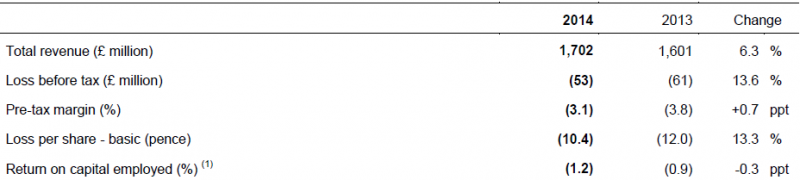
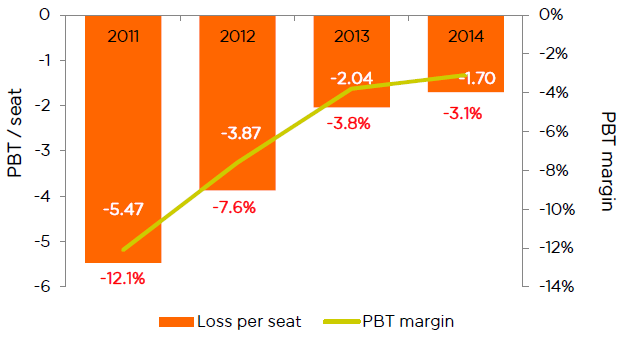
In 1HFY2014 (six months to Mar-2014), easyJet narrowed its loss before tax to GBP53 million from GBP61 million a year earlier. This was a little better than the guidance it gave on 25-Mar-2014 that the loss before tax would be in the range GBP55 million to GBP65 million. It was the third successive year in which the seasonal losses of the winter half were reduced. Its loss per seat was GBP1.70, a 69% reduction in the loss per seat of GBP5.47 in 1HFY2011.
Revenues grew by 6.3% to GBP1,702 million, but return on capital employed dipped slightly to -1.2% from -0.9%. The company's cash balance fell slightly, but remained in excess of GBP1 billion and balance sheet debt also fell, so that its net cash position increased from GBP433 million a year earlier to GBP449 million at the end of Mar-2014.
With the inclusion of operating leases capitalised at seven times annual rentals, net debt as a percentage of total capital employed increased from 1% to 18%, but easyJet still has one of the strongest balance sheets among European airlines.
EasyJet financial highlights: 1HFY2014 vs 1HFY2013

Notes: 1 ROCE shown on a lease adjusted basis with aircraft operating leases capitalised at seven times the annual lease rental.
Gearing defined as (debt + 7 x annual lease payments – cash) divided by (shareholders’ equity + debt +7 x annual lease payments – cash)
Source: easyJet
EasyJet first half pre-tax loss per seat and pre-tax margin, (GBP million): 1H2011 to 1H2014
Source: easyJet
EasyJet seat capacity up 3.6% in 1H2014, with 89% load factor
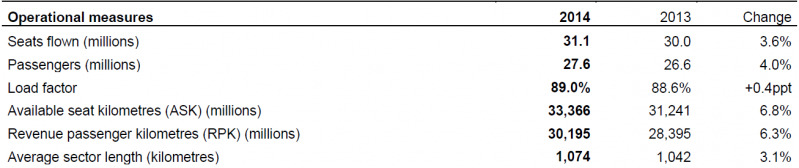
EasyJet added seat capacity at the rate of 3.6% year on year and carried 4.0% more passengers, driving a 0.4 ppt increase in seat load factor to 89.0%. This is a very high load factor for the winter season and easyJet has almost completely eliminated the gap between 1H and 2H load factors: its FY2013 load factor was 89.3%, one of the highest in the industry.
CEO Carolyn McCall said at a presentation to analysts on the 1H results that there was a "constant debate" about the balance between load factor and yield. CFO Chris Kennedy added that easyJet does not target load factor, but total revenue per flight.
Its average sector length increased by 3.1%, driving ASK growth of 6.8%. Its passenger load factor calculated on the basis of RPK divided by ASK actually dipped slightly, from 90.9% to 90.5% (according to our calculations). This decline contrasts with the load factor gain based on the number of passengers divided by the number of seats, implying that the passenger growth in 1H was more concentrated on shorter routes. However, since the ASK load factor is still higher than the seat load factor mentioned above, this implies that longer routes are being filled better than shorter routes.
EasyJet operational KPIs: 1H2014
Source: easyJet
Revenue per seat up 2.6%
Total revenues grew by 6.3%, ahead of the growth in the number of seats, so revenue per seat increased by 2.6% to GBP54.80 (at constant currency, revenue per seat grew by 1.5%). Unit revenue performance was helped by improved capacity allocation across easyJet's route network, improvements to the website and the digital offering, allocated seating and bag charges, increased sector lengths and an 8.5% increase in higher yielding business passengers. In addition, easyJet's competitors cut capacity by 1.3% on its routes in the period.
EasyJet total revenue and revenue per seat: 1H2014


Source: easyJet
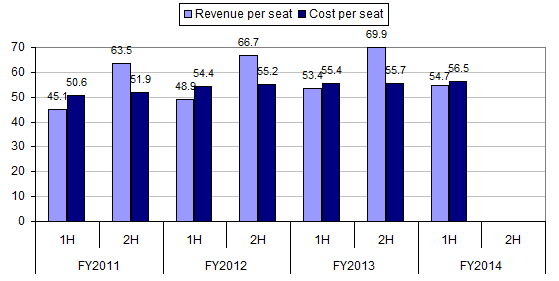
As noted above, seasonal load factor differences have all but been eliminated, but there is still a significant unit revenue difference. EasyJet's 1HFY2014 revenue per seat was much lower than the figure of almost GBP70 for 2H2013 (last northern summer). Winter demand must be stimulated with lower prices, but easyJet's cost per seat in the winter half is typically very similar to its summer cost per seat and this gives rise to seasonal winter losses.
EasyJet has reduced its losses in the winter half year every year since FY2011, because it has grown its 1H revenue per seat by 21%, while holding the increase in 1H cost per seat to 12%.
EasyJet revenue per seat and cost per seat (GBP) by half year: FY2011 to FY2014
Note: cost per seat based on costs at the pre-tax profit level
Source: CAPA - Centre for Aviation, easyJet
Cost per seat up 1.9%
Total cost per seat increased by 1.9%, less than the increase in revenue per seat. Fuel cost per seat grew by 4.6% and ex fuel cost per seat grew by 0.8%, or 0.5% at constant currency. Airport and ground handling cost per seat fell by 2.5% at constant currency, helped by lower de-icing costs, initiatives under the 'easyJet Lean' cost programme and higher load factors.
Crew cost per seat increased by 3.2% at constant currency, due to higher salaries and longer average sector lengths. Average sector lengths also drove higher navigation cost per seat. Maintenance cost per seat increased as a result of a higher number of leased aircraft and increased average fleet age.
The company's 'easyJet Lean' programme delivered savings of GBP14 million in the six months and Mr Kennedy told analysts at the 1H results presentation that he was confident that the programme would continue to provide GBP20 million to GBP30 million every year.
EasyJet cost per seat and year on year change at constant currency: 1HFY2014
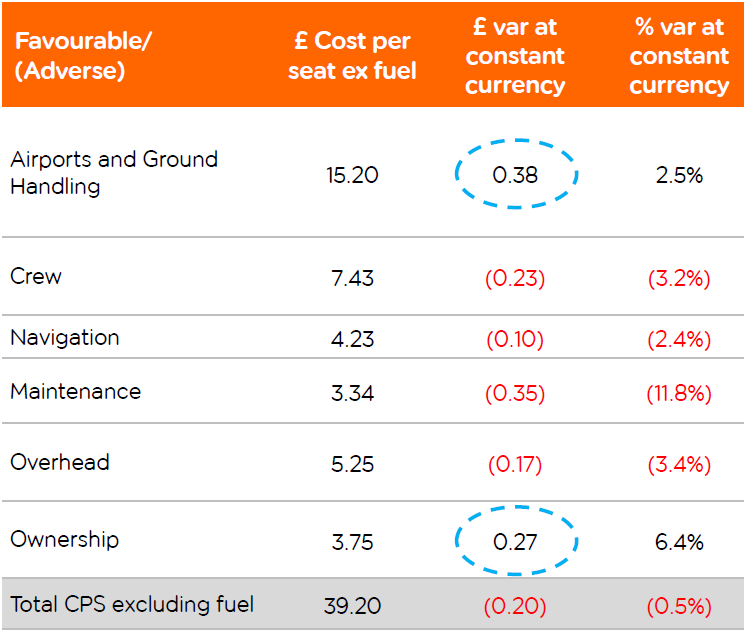
Note: brackets indicate an adverse variance versus 1H2013, ie an increase in cost per seat
Source: easyJet
A320s now 30% of the fleet
EasyJet's fleet increased by a total of 10 aircraft over the 12 months to 31-Mar-2014 to reach 220. Its A319 fleet reduced by one to 153, while its A320 fleet increased by 11 to 67 aircraft.
The higher percentage of A320s in the fleet leads to cost per seat advantages and will continue to rise. The larger A320 gives a cost per seat saving over the A319 of 7% to 8%. From 2018, easyJet will start to take delivery of the A320neo, with a further cost per seat advantage of 4% to 5%.
See related report: easyJet's new Airbus order: let the shareholder battle commence
EasyJet fleet at 31-Mar-2014 vs 31-Mar-2013
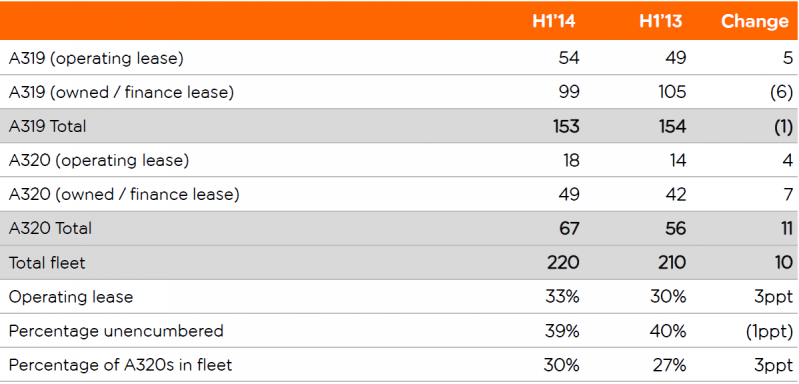
Source: easyJet
EasyJet plans seat growth of 6.7% in 2H2014
In 2HFY2014 (Apr to Sep), easyJet plans seat growth of 6.7% and, according to its analysis of OAG data, competitor growth in easyJet's markets will reach 2.9% this summer, after a cut of 1% last summer. This means that total seat growth in its markets (easyJet plus competitor capacity) will accelerate to 4.1% in summer 2014 from 0.6% in summer 2013, according to the same source. While capacity growth is increasing, easyJet describes it as still being disciplined.
Around one third of easyJet's seat growth (2.6 ppts) this summer comes from its acquisition of Gatwick slots from Flybe, which was effective from Apr-2014. According to Ms McCall, it takes 12 to 18 months to "optimise a slot portfolio" such as that acquired at Gatwick and, although mainly not used for new routes, the additional capacity will take time to mature.
EasyJet, the biggest operator at the airport, is in consultation with Gatwick about consolidating its operations into a single terminal. This move, which easyJet hopes may take effect in 2017, should be beneficial both for the passenger experience and for operational efficiency.
See related report: EasyJet works the Gatwick slot machine as Flybe cashes out
Seat capacity growth in easyJet markets: summer 2014 versus summer 2013
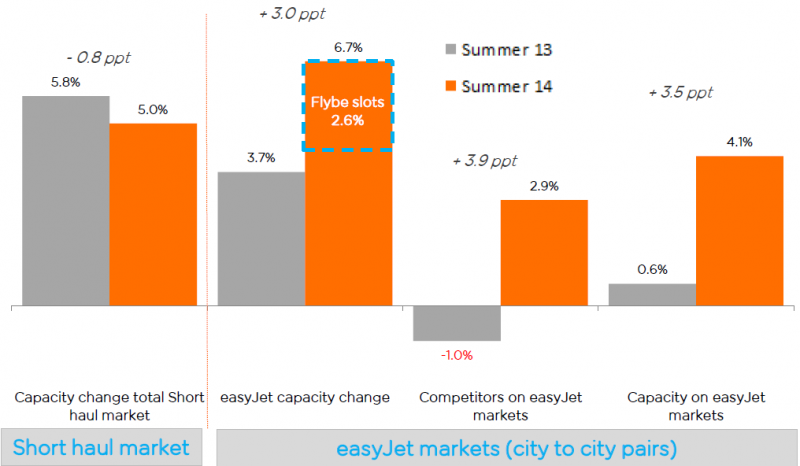
Source: easyJet analysis of OAG data at 30-Apr-2014
Fastest growth planned in Germany, Italy and Switzerland this summer
Focusing on the largest European country markets, easyJet's capacity growth in 2HFY2014 will be highest in Germany (+10%), Italy (+9%) and Switzerland (+8.8%). In France, it plans growth of 7.4%, while in the UK (6.3%) and Spain (4.1%), its growth will be slower. In all these markets, it will grow faster than competitors.
See related report: Vueling, Ryanair, easyJet square up and all surround Alitalia in Rome: the gladiators are back!
As at 9-May-2014, easyJet had sold 51% of its seats for the period Apr-2014 to Sep-2014 (2HFY2014), compared with 50% at the same stage a year ago. The higher level of sales this year is mainly due to the move of Easter from Mar-2013 to Apr-2014, but easyJet also has a slightly higher level of sales across all summer months compared with last year.
EasyJet seat capacity growth in key European markets: summer 2014
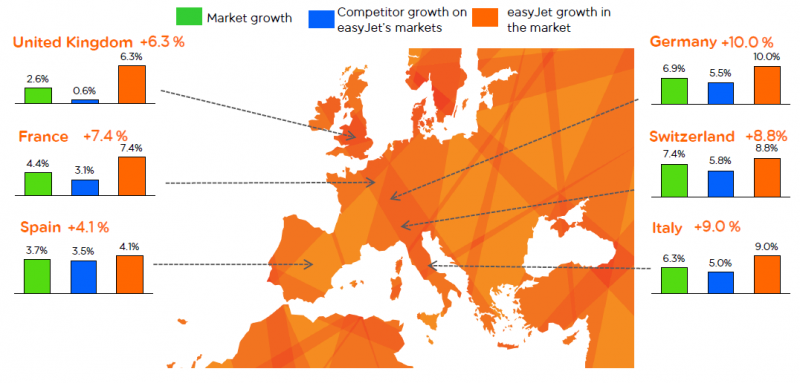
Source: easyJet
ROCE improvements across the network
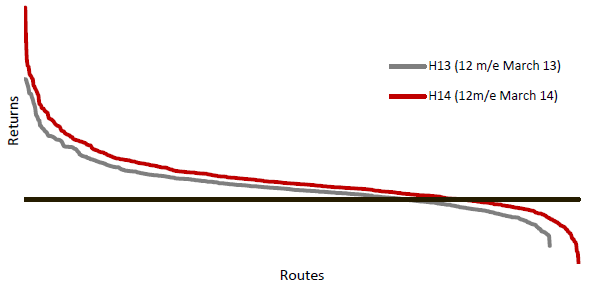
Return on capital employed is a key financial metric for easyJet, both for the company as a whole and on a route by route basis. In the 12 months to Mar-2014, easyJet increased the number of routes beating its target ROCE of 12% and network returns improved overall.
Although total ROCE fell slightly in 1H2014, the key to full year returns is the summer half and the company has consistently improved its FY ROCE since FY2009.
Rolling 12 months returns: Apr-2013 to Mar-2014 vs Apr-2012 to Mar-2013
Source: easyJet
EasyJet's 1H results presentation made reference to IATA's forecast that European short-haul passengers will increase by between 60 million and 70 million by 2018 at an average annual growth rate in the region of 3% pa. The carrier's own analysis of aircraft deliveries suggests an additional 450 narrowbody aircraft will enter the market by 2018, at a similar annual growth rate of around 3%.
Against this backdrop, easyJet's FY2014 seat growth of a little over 5% and medium term planning scenario of annual growth in the range of 3% to 5% looks reasonable. It has a strong pan-European network, which gives it a presence in more of the top 100 city pairs than any other European airline and where it is number one or number two in almost three quarters of its airports. This strong network and its cost advantage versus legacy carriers justify a modest growth premium relative to the market.
FY2014 set to be another year of double digit profit growth
Looking at other elements of the outlook for the rest of FY2014, the movement of Easter into the second half of easyJet's financial year is expected to have a positive impact on its 2H2014 revenue per seat, which the carrier forecasts will grow at a low single digit rate. It expects cost per seat, ex fuel and currency, to be up around 2% in 2H2014 and 2H fuel costs to be up to GBP10 million higher than last year. It also expects a GBP5 million to GBP10 million positive impact from foreign exchange movements, including those related to fuel.
As before, the key variable in easyJet's guidance seems to be revenue per seat. If easyJet were only to repeat its 1H performance of 1.5% growth in revenue per seat at constant currency, the other elements of its guidance would point to a FY2014 pre-tax profit figure of around GBP570 million. This is almost 20% higher than last year and roughly 10% higher than the figure implied by easyJet's guidance in Jan-2014.
Although, as we have previously observed, it does not look possible to repeat the 50% profit growth achieved last year, both the level of profit and the growth targeted for 2014 demonstrate a business that is performing strongly.
Strumentalizza (e non è l'unica) i dati sul traffico business, e nel farlo prova a farsi pubblicità come a dire "se per lavoro la gente ci sceglie siamo eccellenti". Sono 4 anni ormai che mi occupo di U2, e quello che ho notato è che ha un traffico prettamente cost sensitive, con pochi pax "business" nel senso più aulico del termine. I VIP, i politici, i grandi imprenditori, puntano su AZ perché a loro non importa se un a/r nazionale costa 400€, a loro importa viaggiare comodi, guadagnare le miglia, stare nelle lounge, tutte cose che U2 non può garantire. Infatti in questi quattro anni mi sono capitati vari personaggi di prestigio con AZ, e solo uno con U2... Vittorio Sgarbi, che è tutto dire...
E poi, avendo la principale base italiana a MXP, in un Nord dove il traffico business è rilevante, mi sembra normale che tale traffico influenzi U2. Ma non trovo corretto sbandierare il dato in questo modo quando chiunque con una minima esperienza aeroportuale può testimoniare che il pax non cost sensitive evita easyJet, e che un viaggio per lavoro non significa "viaggio che certifica la qualità della compagnia".
forse non hai mai osservato un volo sulla direttrice MXP-CDG-MXP...
@Kenyaprince
Grazie per il post.
@Mobius
Le tue preferenze sono ormai note. Non le condivido ma le rispetto. Il punto fondamentale però è quello che vuole il mercato: e il mercato sta dicendo oltre ogni ragionevole dubbio, che per fare viaggi di un'ora o poco più, tutto quello che serve è un autobus con le ali ad un prezzo abbordabile. Che non significa, bada bene, di 9.99€ al massimo.
Alla stragrande maggioranza dei pax, un servizio offerto con macchine recenti, pulite e con spazio sufficiente (ancorché non abbondante) è tutto ciò che serve per andare da A a B. Di tutti gli orpelli venduti a carissimo prezzo dalle major, non gliene può fregare di meno. Lo spuntino dal valore di 1€, se lo possono anche tenere. Tanto più che se davvero uno avesse fame o sete, può tranquillamente comprare quanto desidera a bordo.
Tu ti ostini a guardare al passato, a quando il viaggio in aereo era considerato un bene di lusso e la clientela ne rifletteva i costi. Oggi non è più così nel bene e nel male. Ma la realtà è questa. Probabilmente a medio termine non esisterà più nulla che non sia LC. Ma non sarà un LC estremo e chiunque potrà costruirsi il viaggio su misura. Già ora VY offre ai propri clienti da fascia alta un'autentica J, con posti nella prima fila con i centrali bloccati, lounge, fast track, catering, flessibilità.
Ma 10 o 20 file più indietro, ci sarà sempre spazio per chi vuole spendere poco e rinuncia volentieri a tutti questi benefit.
È questo il futuro, quello del viaggio su misura. E le major non potranno fare altro che adeguarsi, come infatti hanno iniziato a fare.
Grazie per il post.
@Mobius
Le tue preferenze sono ormai note. Non le condivido ma le rispetto. Il punto fondamentale però è quello che vuole il mercato: e il mercato sta dicendo oltre ogni ragionevole dubbio, che per fare viaggi di un'ora o poco più, tutto quello che serve è un autobus con le ali ad un prezzo abbordabile. Che non significa, bada bene, di 9.99€ al massimo.
Alla stragrande maggioranza dei pax, un servizio offerto con macchine recenti, pulite e con spazio sufficiente (ancorché non abbondante) è tutto ciò che serve per andare da A a B. Di tutti gli orpelli venduti a carissimo prezzo dalle major, non gliene può fregare di meno. Lo spuntino dal valore di 1€, se lo possono anche tenere. Tanto più che se davvero uno avesse fame o sete, può tranquillamente comprare quanto desidera a bordo.
Tu ti ostini a guardare al passato, a quando il viaggio in aereo era considerato un bene di lusso e la clientela ne rifletteva i costi. Oggi non è più così nel bene e nel male. Ma la realtà è questa. Probabilmente a medio termine non esisterà più nulla che non sia LC. Ma non sarà un LC estremo e chiunque potrà costruirsi il viaggio su misura. Già ora VY offre ai propri clienti da fascia alta un'autentica J, con posti nella prima fila con i centrali bloccati, lounge, fast track, catering, flessibilità.
Ma 10 o 20 file più indietro, ci sarà sempre spazio per chi vuole spendere poco e rinuncia volentieri a tutti questi benefit.
È questo il futuro, quello del viaggio su misura. E le major non potranno fare altro che adeguarsi, come infatti hanno iniziato a fare.
Ultima modifica:
forse non hai mai osservato un volo sulla direttrice MXP-CDG-MXP...
O la NCE-FCO, dove ormai c'é uno zoccolo duro di clienti dotata di easyJet plus card che monopolizza le prime file..
O la tanto bistrattata LIN-FCO
E comunque, ricordiamoci che U2 è una compagnia Europea e c'è tutto un mondo al di fuori dell'Italia
E comunque, ricordiamoci che U2 è una compagnia Europea e c'è tutto un mondo al di fuori dell'Italia