
Conflitto in Medio Oriente
- Autore Discussione FLRprt
- Data d'inizio
You are using an out of date browser. It may not display this or other websites correctly.
You should upgrade or use an alternative browser.
You should upgrade or use an alternative browser.

100 dollari fino a tutto il 2027…
Poveri noi

 it.marketscreener.com
Poveri noi
United Airlines taglia nuovi voli: stime sul petrolio sopra i 100 dollari fino al 2027
United Airlines sta procedendo a un ulteriore taglio dei voli non redditizi per i prossimi due trimestri, preparandosi a un periodo prolungato di prezzi elevati del cherosene a causa del conflitto in...

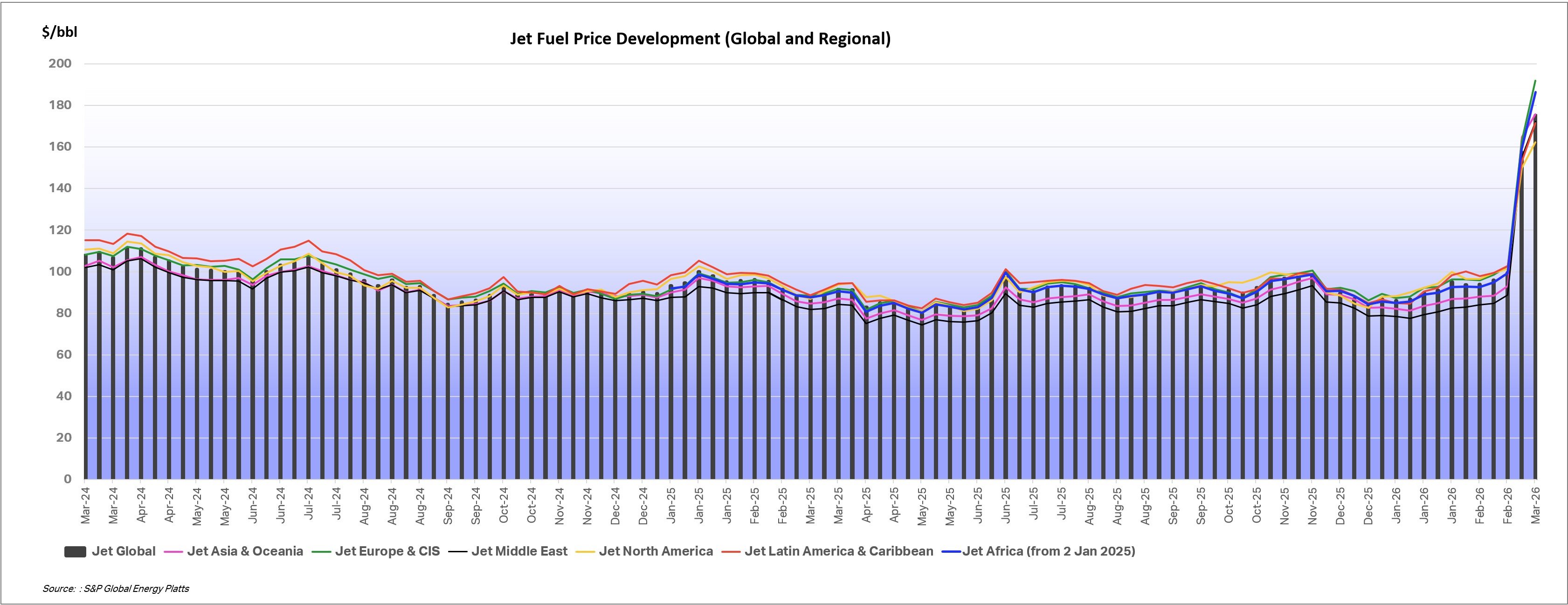
Signori, questi sono i valori del Jet fuel a livello globale e per alcuni hub americani:
View attachment 24669
Daily Jet Fuel Spot Prices | Airlines For America
www.airlines.org
Jet Fuel Price Monitor
The Jet Fuel price index provides weekly updates of the jet fuel price, price index, yearly price average and the impact on the fuel bill of the global airline industrywww.iata.org
A livello globale si è passati da 100/120 %/bbl a $180, nel giro di due settimane. In America si è passati da $2.50 a $4.80/gal. È sabato mattina, è una bella giornata e fuori ci sono gli stornelli che cinguettano, per cui non voglio partire subito con l'invettiva contro gli imbecilli che hanno creato questo casino, però è indubbio che ci saranno enormi problemi a venire. Tantopiù che, considerando le parti in causa, mi sa che le cose non si risolveranno tanto presto.
Ogni qualvolta trovate un gonzo che vi dirà: " XXX è meglio di XYZ perchè ha una politica isolazionista degli USA" ...ecco...mettetegli una scarpa in bocca.
Dopo EK e EY anche Flydubai annuncia una forte ripresa dei voli, da fine marzo vengono riaperte 29 destinazioni, mentre ne restano sospese 21.
Per l'Italia:
Dubai – Catania 3 weekly 737 MAX 8
Dubai – Milan Bergamo 10 weekly 737 MAX 8
Dubai – Naples 1 daily 737 MAX 8
Dubai – Pisa 3 weekly 737 MAX 8 from 31MAR26 (service resumption)
Notizia completa su airlineroute
Per l'Italia:
Dubai – Catania 3 weekly 737 MAX 8
Dubai – Milan Bergamo 10 weekly 737 MAX 8
Dubai – Naples 1 daily 737 MAX 8
Dubai – Pisa 3 weekly 737 MAX 8 from 31MAR26 (service resumption)
Notizia completa su airlineroute

Io c’avevo na bella Cadillac foderata de pelle d’anguillaci sono gli stornelli che cinguettano
mo ve ricconto di come m’è annata,
che in quattro e quattr’otto l’ho rottamata!
Vado ar distributore pe fa la benzina,
m’hanno fatto na rapina,
La porto ar meccanico pe faje er tajando
guardo er listino e a momenti svengo!
L’ho parcheggiata sotto la porta,
m’hanno arubbato la rota de scorta
l’ho spostata da n’antra via,
me voleva sparà la polizia!
Si tu guarda è robba da scemi,
mo lo zio Donald bombarda l’iraniani,
l’amico suo da Israele
je da na mano a sdilombà er potere!
Se volete continuo!


Airline industry hit by biggest crisis since pandemic
Middle East war has unleashed severe disruption for the aviation sector
Peter Campbell in Brussels and Rachel Rees in London
The airline industry is in the grip of its worst crisis since the pandemic, as the Middle East war has grounded flights, wiped more than $50bn off the value of the world’s biggest carriers and even raised the spectre of fuel shortages.
As the conflict headed into a fourth week, executives sounded the alarm on its repercussions for an industry exposed to a prolonged increase in oil prices, disruption to the Gulf’s hub airports and a potential hit to global demand.
Passengers on routes far beyond the Gulf are set to face a steep increase in ticket prices in coming months as airlines attempt to shield their profits. Jet fuel, which accounts for a third of airlines’ costs, has doubled since the US and Israel launched their attacks on Iran last month and is still rising.
Although many carriers are hedged against swings in oil prices, executives warned that the precipitous rise in the cost of jet fuel this month would force them to lift fares.
“Fuel spiked quite heavily after the Ukraine invasion in 2022 as well, but this has gone further north,” said easyJet chief executive Kenton Jarvis, adding that the conflict marked the severest upheaval for the industry since the pandemic closed the skies in 2020.
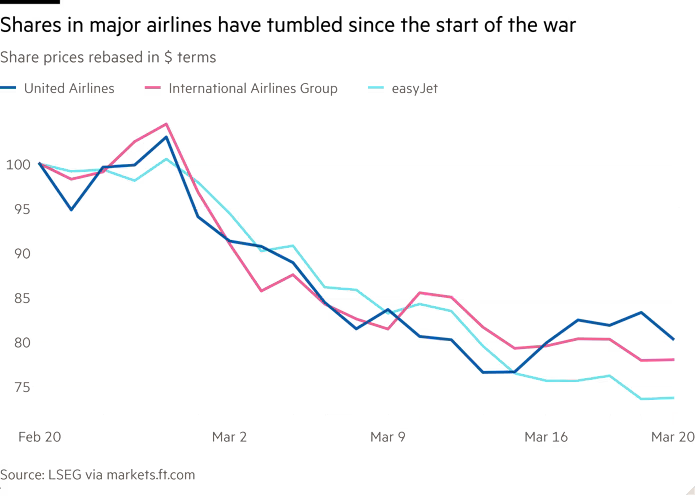
In a sign of investors’ alarm, the 20 largest publicly listed airlines have lost about $53bn in market capitalisation since the war began, according to FT calculations.
Investors have also increased their bets on further declines in share prices, with Wizz Air, a low-cost European carrier, now the most shorted company on the FTSE 100, and easyJet also targeted.
The crisis has struck following a sustained rebound in demand since the pandemic, with several airlines enjoying a run of record profits. Nevertheless, executives are wary that demand can withstand much higher ticket prices.
Carsten Spohr, the chief executive of Lufthansa, said he feared higher prices could dent demand over the longer term but insisted that Germany’s largest airline had no choice but to raise fares.
“Our average profit is about €10 per passenger, there’s no way you can absorb the additional cost,” he said.
In an indication of how the disruption is ricocheting across the sector, airlines are drawing up contingency plans in the event of a shortage of jet fuel.
Ben Smith, chief executive of Air France-KLM, said that the carrier was putting plans in place to cope with a squeeze in supplies, including cutting services to parts of Asia.
Executives said that the epicentre of the crisis remained in the Gulf, where the state-backed trio of Emirates, Etihad and Qatar have been forced to dramatically cut back their schedules amid airspace closures and the collapse of the region’s tourism.
“For the guys in the Middle East, this is a big crisis,” said Willie Walsh, head of airlines lobby group Iata and the former boss of BA, adding that it remained dwarfed by the crisis that engulfed the industry during the pandemic.
This is “more akin to the post-9/11 transatlantic issues where demand for transatlantic flying declined significantly”, he added.
Given the scale of the disruption, Andrew Charlton, head of Aviation Advocacy, a consultancy, said that the Gulf’s flag carriers were likely to require cash injections from their state owners.
“If you’re an airline without state backing you are going to be in trouble,” he said.
The disruption has extended to cargo as freight from heavily disrupted global shipping shifts to aircraft, leaving some airports overwhelmed.
Goods sent to Geneva airport are being driven to Paris because planes taking off from the Swiss base are full, according to Giovanni Russo, who heads operations at the airport.
As the industry reels from the conflict, Jarvis, the head of easyJet, said he expected airlines’ share prices would quickly rebound when the war ends.
“The share price has moved against all airlines since the start of the conflict,” said easyJet CEO Jarvis. “I think they’ll close [short sellers] their position quite quickly if any ceasefires are announced.”
Airlines draw up contingency plans over jet fuel shortage fears
War in the Middle East is disrupting supplies and driving up prices
Peter Campbell in Brussels and Ryohtaroh Satoh and Malcolm Moore in London
Airlines are drawing up contingency plans to deal with potential jet fuel shortages, which they fear could take hold within weeks as war in the Middle East threatens supplies and drives up prices.
Aviation executives said they were struggling to get assurances about the availability of fuel beyond the next month.
“We’re putting in plans today to draw up scenarios on how we would deal with the shortage of fuel,” said Ben Smith, chief executive of Air France-KLM. This includes cutting services to parts of Asia in case refuelling for the return journey to Europe becomes more difficult.
“South-east Asia is much more dependent on fuel coming over the Gulf than Europe is,” Smith told the FT. “We can get fuel out of Europe, but when we go to [a] south-east Asian city we’re not going to be able to fly the plane back . . . If there’s no fuel, you can’t fly.”
EasyJet boss Kenton Jarvis said fuel suppliers will not give guidance on availability beyond the next month.
Suppliers had reassured the airline they have fuel for the next three weeks, he said. “But no one’s really telling us ‘we have no immediate issues in six weeks’, because they’re not prepared to say that,” he added.
Some energy traders believe jet fuel shortages are inevitable in parts of the world.
They said that while some countries, including in Europe, have healthy reserves, planes still need to refuel at their destinations and cannot carry enough for return trips.
Other fuels facing shortages include marine fuel and LPG.
The immediate risk is mitigated because airports typically have significant stocks.
Hari Marar, chief executive of India’s Bangalore International Airport, said it has fuel for about 25 days on site or nearby. Shortages are not “an immediate concern,” he said. “Price is a different matter and that will definitely impact our airline partners.”
However, Vietnam has already warned of the possibility that flights from the country will have to be limited.
“This is a bigger supply issue than we’ve seen before,” said Willie Walsh, the former British Airways CEO who now runs industry group Iata.
Several airport executives told the FT this week that they face shortages of fuel that may force them to limit flights in the coming weeks.
“In the short term, the big issue is not so much the fuel prices as whether there is going to be enough,” said Justin Erbacci, head of global airports industry group ACI World. “Everybody’s worried right now about potential availability.”
Jet fuel prices have doubled since the US and Israel launched strikes on Iran last month. North-west European prices hit an all-time high on Wednesday, closing at $1,730 a tonne, beating a record set on Monday to reach roughly double prewar levels, according to pricing agency Argus Media.
Price rises have left some airlines, including US carriers such as United, Delta and American Airlines, with billions in extra costs because they do not have long-term hedging. Scandinavian airline SAS, which is not hedged, this week said it would cancel around 1,000 flights because of rising fuel prices.
Disruption in the Strait of Hormuz has halted supplies from Kuwait, the world’s second-largest jet fuel exporter, which accounted for 15 per cent of global seaborne jet fuel exports in 2025, according to energy data company Vortexa.
Analysts said Europe and Australia were likely to be hit harder than other markets because of limited domestic refining capacity. Europe has shut much of its refining capacity in recent years and now sources about 40 per cent of its jet fuel through the Strait, while Australia depends heavily on refineries in China and Singapore.
Suppliers in Asia are also tightening exports of jet fuel and other refined products. China ordered a halt to refined fuel exports last week, while South Korea, another key supplier, imposed a cap on refined product exports.
Not everyone in the industry is concerned about shortages. Ryanair boss Michael O’Leary said his airline, which only serves Europe, does not expect any shortages in the next two months under current conditions.
100 dollari fino a tutto il 2027…
Poveri noi
United Airlines taglia nuovi voli: stime sul petrolio sopra i 100 dollari fino al 2027
United Airlines sta procedendo a un ulteriore taglio dei voli non redditizi per i prossimi due trimestri, preparandosi a un periodo prolungato di prezzi elevati del cherosene a causa del conflitto in...
Dice che stanno lavorando ad uno scenario che preveda 100 fino al 2027, non che sarà così

Confindustria ha stimato che ogni 10 giorni di conflitto il corrispettivo aumento della nostra bolletta energetica nazionale si traduce in uno 0,2 di PIL annuo in meno.
Un ottimo motivo per accelerare la transizione energetica a rinnovabili e nucleare, IMHO.

Stavo pensando esattamente la stessa cosa. In questo momento storico la classe politica dovrebbe mettere da parte le divisioni per il bene comune. Raggiungere prima possibile l'autonomia energetica non è un valore di destra o di sinistra, è un valore per lo stato, cioè per tutti noi.Un ottimo motivo per accelerare la transizione energetica a rinnovabili e nucleare, IMHO.
Io sono d'accordo sul nucleare, ma la materia prima non si trova a casa nostra.Un ottimo motivo per accelerare la transizione energetica a rinnovabili e nucleare, IMHO.
Energia solare? Di nuovo la materia prima non è in casa.
Ok diversificazione, ma non soluzione.
Purtroppo anche per l'esperto, il barometro volge al brutto tempo.
LORENZO MANTIGLIONI
Chi comanda ora in Iran? Uccisi Larijani e Soleimani e senza Khamenei, spunta il falco Vahidi
Roma, 18 marzo 2026 – Con l’uccisione del comandante dell’unità Basij, Gholamreza Soleimani, e soprattutto del segretario del Consiglio supremo per la sicurezza nazionale, Ali Larijani – confermata in serata da parte di Teheran –, appare sempre più probabile che l’asse del potere nella Repubblica islamica sia passato nelle mani dei pasdaran.
E tra questi emerge la figura del loro capo, Ahmad Vahidi, l’uomo che in questo momento tiene le redini sia del sistema governativo sia delle operazioni militari.
Una deriva, legata all’uccisione di Larijani, che non solo elimina il dualismo che insisteva al vertice del regime – quello tra la prima generazione di stampo clericale e la seconda legata alle Guardie della rivoluzione –, ma che potrebbe anche chiudere qualsiasi possibilità di un negoziato con Washington.
E questo perché i pasdaran, nonostante al loro interno vi siano posizioni divergenti, interpretano la guerra come una questione esistenziale.
“La componente delle Guardie della rivoluzione – commenta Nicola Pedde, direttore generale dell’Institute for Global Studies (Igs) ed esperto di geopolitica del Medio Oriente – non vuole un dialogo. E non credo ci sia la possibilità che possa emergere una figura in grado di farlo: si tratterebbe, infatti, di un’ipotesi non accettabile per i pasdaran e, paradossalmente, neanche per Israele, che non è interessato a una transizione interna”.
A complicare il quadro c’è poi il nuovo leader in pectore della Repubblica islamica, Ahmad Vahidi. Il capo dei pasdaran è espressione dell’ala più conservatrice del gruppo, un “falco” della prima ora che ha combattuto la guerra tra Iran e Iraq ed è tra i fondatori della Quds Force, il reparto altamente addestrato delle Guardie della rivoluzione.
Poco incline al dialogo con l’Occidente, Vahidi incarna l’opposizione più netta al divieto di sviluppo delle armi nucleari imposto dall’ex Guida suprema Ali Khamenei.
“Vahidi – spiega Pedde – è una figura molto più assertiva nelle prerogative di difesa del Paese. Non credo che, per il momento, cambierà l’assetto dell’Iran, dato che l’esercizio del potere politico e soprattutto militare è nelle mani del Consiglio supremo per la sicurezza nazionale, organo ampiamente controllato dai pasdaran. Di fatto, Vahidi controlla il Paese senza il bisogno di un particolare incarico istituzionale”.
Sullo sfondo resta l’incognita della nuova Guida suprema, Mojtaba Khamenei. Una figura sempre più defilata, intorno alla quale aleggia il mistero delle sue reali condizioni di salute.
Nei giorni scorsi si era diffusa l’ipotesi che Khamenei si trovasse in Russia per sottoporsi a un intervento chirurgico, ma questa ricostruzione è stata smentita dall’ambasciatore iraniano a Mosca, Kazem Jalali.
“Ammesso che sia ancora vivo o in grado di esercitare qualche funzione – sostiene Pedde –, Mojtaba Khamenei non è il leader del Paese, ma il legittimatore del potere delle Guardie della rivoluzione. Non è certo comparabile, per peso politico, alla figura del padre”.

LORENZO MANTIGLIONI
Chi comanda ora in Iran? Uccisi Larijani e Soleimani e senza Khamenei, spunta il falco Vahidi
Vertice decapitato, le redini del Paese al capo dei pasdaran. Pedde (Igs): “Ora il dialogo con gli Usa diventa molto difficile”
Roma, 18 marzo 2026 – Con l’uccisione del comandante dell’unità Basij, Gholamreza Soleimani, e soprattutto del segretario del Consiglio supremo per la sicurezza nazionale, Ali Larijani – confermata in serata da parte di Teheran –, appare sempre più probabile che l’asse del potere nella Repubblica islamica sia passato nelle mani dei pasdaran.
E tra questi emerge la figura del loro capo, Ahmad Vahidi, l’uomo che in questo momento tiene le redini sia del sistema governativo sia delle operazioni militari.
Una deriva, legata all’uccisione di Larijani, che non solo elimina il dualismo che insisteva al vertice del regime – quello tra la prima generazione di stampo clericale e la seconda legata alle Guardie della rivoluzione –, ma che potrebbe anche chiudere qualsiasi possibilità di un negoziato con Washington.
E questo perché i pasdaran, nonostante al loro interno vi siano posizioni divergenti, interpretano la guerra come una questione esistenziale.
“La componente delle Guardie della rivoluzione – commenta Nicola Pedde, direttore generale dell’Institute for Global Studies (Igs) ed esperto di geopolitica del Medio Oriente – non vuole un dialogo. E non credo ci sia la possibilità che possa emergere una figura in grado di farlo: si tratterebbe, infatti, di un’ipotesi non accettabile per i pasdaran e, paradossalmente, neanche per Israele, che non è interessato a una transizione interna”.
A complicare il quadro c’è poi il nuovo leader in pectore della Repubblica islamica, Ahmad Vahidi. Il capo dei pasdaran è espressione dell’ala più conservatrice del gruppo, un “falco” della prima ora che ha combattuto la guerra tra Iran e Iraq ed è tra i fondatori della Quds Force, il reparto altamente addestrato delle Guardie della rivoluzione.
Poco incline al dialogo con l’Occidente, Vahidi incarna l’opposizione più netta al divieto di sviluppo delle armi nucleari imposto dall’ex Guida suprema Ali Khamenei.
“Vahidi – spiega Pedde – è una figura molto più assertiva nelle prerogative di difesa del Paese. Non credo che, per il momento, cambierà l’assetto dell’Iran, dato che l’esercizio del potere politico e soprattutto militare è nelle mani del Consiglio supremo per la sicurezza nazionale, organo ampiamente controllato dai pasdaran. Di fatto, Vahidi controlla il Paese senza il bisogno di un particolare incarico istituzionale”.
Sullo sfondo resta l’incognita della nuova Guida suprema, Mojtaba Khamenei. Una figura sempre più defilata, intorno alla quale aleggia il mistero delle sue reali condizioni di salute.
Nei giorni scorsi si era diffusa l’ipotesi che Khamenei si trovasse in Russia per sottoporsi a un intervento chirurgico, ma questa ricostruzione è stata smentita dall’ambasciatore iraniano a Mosca, Kazem Jalali.
“Ammesso che sia ancora vivo o in grado di esercitare qualche funzione – sostiene Pedde –, Mojtaba Khamenei non è il leader del Paese, ma il legittimatore del potere delle Guardie della rivoluzione. Non è certo comparabile, per peso politico, alla figura del padre”.
Chi comanda ora in Iran? Uccisi Larijani e Soleimani e senza Khamenei, spunta il falco Vahidi
Vertice decapitato, le redini del Paese al capo dei pasdaran. Pedde (Igs): “Ora il dialogo con gli Usa diventa molto difficile”
www.quotidiano.net
Stavo pensando esattamente la stessa cosa. In questo momento storico la classe politica dovrebbe mettere da parte le divisioni per il bene comune. Raggiungere prima possibile l'autonomia energetica non è un valore di destra o di sinistra, è un valore per lo stato, cioè per tutti noi.
Ci si deve anche muovere a livello europeo. Ascoltavo, perchè sono una persona divertente e l’anima delle feste, un podcast sul nuovo piano quinquennale cinese. Questi stanno già progettando il POST net-zero. Qui in UK c’abbiamo ancora i reazionari che blaterano contro net-zero. L’UE deve fare visione a lungo termine così.
Io sono d'accordo sul nucleare, ma la materia prima non si trova a casa nostra.
Energia solare? Di nuovo la materia prima non è in casa.
Ok diversificazione, ma non soluzione.
La materia prima per il nucleare è l’ultimo dei problemi del nucleare, specie se comparata al rischio geopolitico derivante dal dover prendere il gas dove lo prendiamo ora. Per i pannelli, la cosa è ancor meno preoccupante.
Certamente ci sono problemi da risolvere, ma resta il vantaggio che una volta costruite queste infrastrutture, procurarsi il necessario per l'ordinaria manutenzione, diciamo così, è relativamente facile. E si possono fare scorte che vanno molto oltre quelle permesse da petrolio e gas, soprattutto di materiale fissile.Io sono d'accordo sul nucleare, ma la materia prima non si trova a casa nostra.
Energia solare? Di nuovo la materia prima non è in casa.
Ok diversificazione, ma non soluzione.
Purtroppo l'UE al momento è troppo scollegata dalla realtà per poterne aspettare i tempi biblici. La tristissima verità è che nonostante tutto a Bruxelles ogni stato vede solo gli interessi del proprio orticello. Quando leggo di accordi per la gestione del post-Ucraina, del post Stretto di Hormuz e cose del genere, ho proprio l'impressione che gli stati della UE siano sopraffatti da una accelerazione delle storia che si rifiutano di guardare per quella che è. E tantomeno siano in grado di prendere provvedimenti. E' quindi il caso che a Roma si diano da fare in proprio per risolvere quanto prima (e parliamo comunque di anni se non decenni), le due questioni esistenziali di energia e difesa. Se poi qualcuno si vuole accodare su questa posizione, è solo il benvenuto (quello che ho scritto non deve essere letto in chiave nazionalista), ma è necessario sgranare gli occhi, prendere atto della situazione e cominciare a correre.Ci si deve anche muovere a livello europeo. Ascoltavo, perchè sono una persona divertente e l’anima delle feste, un podcast sul nuovo piano quinquennale cinese. Questi stanno già progettando il POST net-zero. Qui in UK c’abbiamo ancora i reazionari che blaterano contro net-zero. L’UE deve fare visione a lungo termine così.
La materia prima per il nucleare è l’ultimo dei problemi del nucleare, specie se comparata al rischio geopolitico derivante dal dover prendere il gas dove lo prendiamo ora. Per i pannelli, la cosa è ancor meno preoccupante.
I tempi sono biblici per forza, anche per la Cina. L’importante è iniziare e creare le basi, e io sono moderatamente ottimista; dopo il Covid e la guerra in Ucraina ho visto l’UE fare cose che mai avrei pensato potesse fare.
Gli unici scogli, IMHO, sono la necessitá patologica dei francesi di dover comandare anche quando non c’entrano un cazzo, o i soliti slovacchi e ungheresi che, prima o poi, andranno sbattuti fuori se non smettono di trollare.
Gli unici scogli, IMHO, sono la necessitá patologica dei francesi di dover comandare anche quando non c’entrano un cazzo, o i soliti slovacchi e ungheresi che, prima o poi, andranno sbattuti fuori se non smettono di trollare.
Manco c’era bisogno degli esperti per capirlo, che più fai fuori personaggi di primo piano, e più vengono su i gregari che con la diplomazia hanno poco o niente a che spartire, e che a questo punto hanno pure l’appoggio di chi prima non lo dava, per puro principio di sovranità. Ottimo risultato niente da dire.Purtroppo anche per l'esperto, il barometro volge al brutto tempo.
LORENZO MANTIGLIONI
Chi comanda ora in Iran? Uccisi Larijani e Soleimani e senza Khamenei, spunta il falco Vahidi
Vertice decapitato, le redini del Paese al capo dei pasdaran. Pedde (Igs): “Ora il dialogo con gli Usa diventa molto difficile”
Roma, 18 marzo 2026 – Con l’uccisione del comandante dell’unità Basij, Gholamreza Soleimani, e soprattutto del segretario del Consiglio supremo per la sicurezza nazionale, Ali Larijani – confermata in serata da parte di Teheran –, appare sempre più probabile che l’asse del potere nella Repubblica islamica sia passato nelle mani dei pasdaran.
E tra questi emerge la figura del loro capo, Ahmad Vahidi, l’uomo che in questo momento tiene le redini sia del sistema governativo sia delle operazioni militari.
Una deriva, legata all’uccisione di Larijani, che non solo elimina il dualismo che insisteva al vertice del regime – quello tra la prima generazione di stampo clericale e la seconda legata alle Guardie della rivoluzione –, ma che potrebbe anche chiudere qualsiasi possibilità di un negoziato con Washington.
E questo perché i pasdaran, nonostante al loro interno vi siano posizioni divergenti, interpretano la guerra come una questione esistenziale.
“La componente delle Guardie della rivoluzione – commenta Nicola Pedde, direttore generale dell’Institute for Global Studies (Igs) ed esperto di geopolitica del Medio Oriente – non vuole un dialogo. E non credo ci sia la possibilità che possa emergere una figura in grado di farlo: si tratterebbe, infatti, di un’ipotesi non accettabile per i pasdaran e, paradossalmente, neanche per Israele, che non è interessato a una transizione interna”.
A complicare il quadro c’è poi il nuovo leader in pectore della Repubblica islamica, Ahmad Vahidi. Il capo dei pasdaran è espressione dell’ala più conservatrice del gruppo, un “falco” della prima ora che ha combattuto la guerra tra Iran e Iraq ed è tra i fondatori della Quds Force, il reparto altamente addestrato delle Guardie della rivoluzione.
Poco incline al dialogo con l’Occidente, Vahidi incarna l’opposizione più netta al divieto di sviluppo delle armi nucleari imposto dall’ex Guida suprema Ali Khamenei.
“Vahidi – spiega Pedde – è una figura molto più assertiva nelle prerogative di difesa del Paese. Non credo che, per il momento, cambierà l’assetto dell’Iran, dato che l’esercizio del potere politico e soprattutto militare è nelle mani del Consiglio supremo per la sicurezza nazionale, organo ampiamente controllato dai pasdaran. Di fatto, Vahidi controlla il Paese senza il bisogno di un particolare incarico istituzionale”.
Sullo sfondo resta l’incognita della nuova Guida suprema, Mojtaba Khamenei. Una figura sempre più defilata, intorno alla quale aleggia il mistero delle sue reali condizioni di salute.
Nei giorni scorsi si era diffusa l’ipotesi che Khamenei si trovasse in Russia per sottoporsi a un intervento chirurgico, ma questa ricostruzione è stata smentita dall’ambasciatore iraniano a Mosca, Kazem Jalali.
“Ammesso che sia ancora vivo o in grado di esercitare qualche funzione – sostiene Pedde –, Mojtaba Khamenei non è il leader del Paese, ma il legittimatore del potere delle Guardie della rivoluzione. Non è certo comparabile, per peso politico, alla figura del padre”.
Chi comanda ora in Iran? Uccisi Larijani e Soleimani e senza Khamenei, spunta il falco Vahidi
Vertice decapitato, le redini del Paese al capo dei pasdaran. Pedde (Igs): “Ora il dialogo con gli Usa diventa molto difficile”www.quotidiano.net
Linea alta tensione Foggia-Forlì operativa non prima del 2034, ragionevole pensare a fine anni '30, linea Montalto-Milano ancora in fase di discussione. Entrambe sono indispensabili per sviluppare veramente il trasporto di rinnovabili da sud al nord.Un ottimo motivo per accelerare la transizione energetica a rinnovabili e nucleare, IMHO.
Butta male: Qatar inizia col long term storage, 1 A380, 3 A350 e 1 B789 a Terue
View attachment 24662l
Lenny ringraziaButta male: Qatar inizia col long term storage, 1 A380, 3 A350 e 1 B789 a Terue
View attachment 24662l

Guerra in Medio Oriente, Qatar Airways sposta gli aerei in Spagna per difenderli dagli attacchi iraniani
Negli ultimi giorni quasi 20 jet della compagnia di Doha sono stati spostati a Teruel, un ex aeroporto militare. Altri arriveranno nei prossimi giorni