

Come di consueto IATA ha da poco rilasciato la versione aggiornata del suo documento di previsioni di andamento del settore per il 2026.
Metto qui sotto gli highlights e qualche mio commento:
Global trade has been surprisingly resilient, despite the volatile trade policy environment. Air cargo came to everybody’s rescue as a critical enabler of rapid adaptation, ensuring that goods arrived ahead of announced tariff deadlines and facilitating the swift rerouting of China’s exports to alternative markets. Air cargo is also playing an increasingly central role in the growing trade in AI-related goods. While trade growth may slow in 2026, air cargo is well-positioned to remain robust, benefiting from AI driven investment, growing demand for high-value, time-sensitive goods, and the structural shift toward-commerce. In times of uncertainty, when speed matters most, air freight remains the preferred option. As a result, air cargo traffic is projected to grow by 2.6% in 2026.
• While artificial intelligence and the associated tradeflows are an opportunity for air cargo, it is much less helpful for the global energy transition. Growing electricity demand from data centers is increasing competition for limited renewable energy, making it harder to secure affordable inputs for Sustainable Aviation Fuel (SAF). Without coordinated policy to prioritize renewables and safeguard liquid fuel needs, this could delay aviation’s decarbonization and divert investment away from critical climate solutions.
• For 2026, we forecast a 4.9% YoY growth in passenger traffic (measured in RPK), led by the AsiaPacific region’s expansion by 7.3%. This marginal deceleration over 2025 is mainly because of persistent supply-side constraints, including limited aircraft availability, and labor shortages. Supply constraints continue to keep load factors at record highs, projected at 83.8%, which in turn supports yields and profits in an otherwise turbulent operating environment. Resilient traffic growth, together with stable yields should allow the industry to top the USD 1 trillion revenues for the first time in 2025.
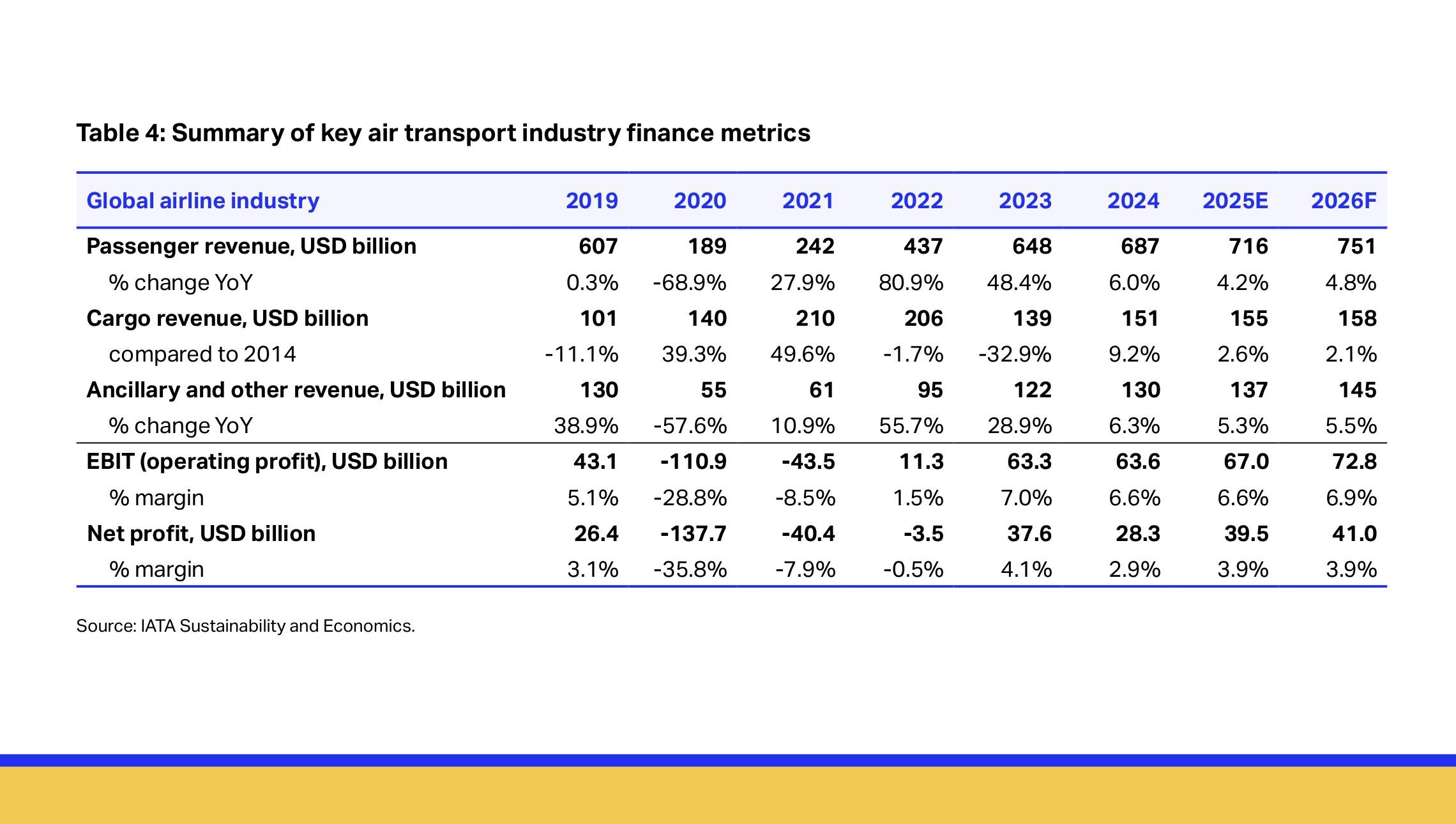
• Record high load factors and fleet utilization, together with a rapid expansion of ancillary revenues, will allow airlines to maintain a relatively healthy profit amid the headwinds, with record high net profit of USD 41 billion in 2026, and a stable net margin of 3.9%. This impressive achievement should be possible despite softening fares and continuous cost pressure. It must be said, though, that the airline industry remains a low-margin industry. At the higher end of the spectrum, single companies can realize our entire industry’s total annual profit in a single quarter.
• Regionally, Europe is set to deliver the highest net profit, very much thanks to Turkey’s stellar performance. The Middle East is the region with the highest profit margins. Asia Pacific is where grow this the most rapid, and Latin America shows signs of structural improvement. North America faces new headwinds, including stagnating domestic demand and operational constraints, yet it remains a key contributor to industry profitability.
• Sustainability is a priority for the airline industry, which is firmly committed to achieving net zero CO2 emissions by 2050. Key solutions for the industry’s decarbonization are not coming to market fast enough. SAF is projected to cover lessthan 1% of total fuel consumption in 2026, in an unambiguous verdict on how ineffective the current policy environment is. This unfortunately extends to the lack of harmonization between CORSIA and a multitude of other regional and national initiatives that cause fragmentation, raise costs, and curtail actual emissions reductions. Policy makers must show the will to address the energy transition at the global level, allowing all industries to operate with both financial and environmental sustainability.
Qualche commento a caldo:
Air cargo is also playing an increasingly central role in the growing trade in AI-related goods. Ecco, con una buona fetta del mercato finanziario che si aspetta una esplosione della bolla AI da un momento all'altro, a me personalmente questa crescente influenza anche sul settore Aviation del mercato AI-related inquieta, e non poco. Per fortuna non di solo AI-related campa il cargo, che infatti "is projected to grow by 2.6% in 2026."
Load factors at record highs, projected at 83.8%: ecco, con buona pace di chi viaggia STDBY

Resilient traffic growth, together with stable yields should allow the industry to top the USD 1 trillion revenues for the first time in 2025. Se, e ripeto, se ITA non dovesse raggiungere i suoi obiettivi nel 2026, li prego sin d'ora di non inserire nelle note a corredo la frase "per avverse condizioni di mercato" o varianti simili. Non regge, anche perché we forecast a 4.9% YoY growth in passenger traffic (measured in RPK) ma soprattutto Regionally, Europe is set to deliver the highest net profit.
SAF is projected to cover less than 1% of total fuel consumption in 2026, in an unambiguous verdict on how ineffective the current policy environment is. E qui la dico alla romana: n'è che gnente gnente sta venendo fuori che in un settore che margina in media neanche il 4% ad essere generosi, l'extra costo del SAF non è assorbibile? Fare gli ecologisti col culo degli altri non porta lontano (ogni riferimento al settore automotive europeo è voluto e rimarcato). Citofonare Timmermans, con un randello in mano.
Ad ogni modo, conforta sapere che per il 2025 ma ancor di più nel 2026 si prevedono rose, fiori ed incensi profumati (si veda tabella qui sotto).
Metto qui sotto gli highlights e qualche mio commento:
Global trade has been surprisingly resilient, despite the volatile trade policy environment. Air cargo came to everybody’s rescue as a critical enabler of rapid adaptation, ensuring that goods arrived ahead of announced tariff deadlines and facilitating the swift rerouting of China’s exports to alternative markets. Air cargo is also playing an increasingly central role in the growing trade in AI-related goods. While trade growth may slow in 2026, air cargo is well-positioned to remain robust, benefiting from AI driven investment, growing demand for high-value, time-sensitive goods, and the structural shift toward-commerce. In times of uncertainty, when speed matters most, air freight remains the preferred option. As a result, air cargo traffic is projected to grow by 2.6% in 2026.
• While artificial intelligence and the associated tradeflows are an opportunity for air cargo, it is much less helpful for the global energy transition. Growing electricity demand from data centers is increasing competition for limited renewable energy, making it harder to secure affordable inputs for Sustainable Aviation Fuel (SAF). Without coordinated policy to prioritize renewables and safeguard liquid fuel needs, this could delay aviation’s decarbonization and divert investment away from critical climate solutions.
• For 2026, we forecast a 4.9% YoY growth in passenger traffic (measured in RPK), led by the AsiaPacific region’s expansion by 7.3%. This marginal deceleration over 2025 is mainly because of persistent supply-side constraints, including limited aircraft availability, and labor shortages. Supply constraints continue to keep load factors at record highs, projected at 83.8%, which in turn supports yields and profits in an otherwise turbulent operating environment. Resilient traffic growth, together with stable yields should allow the industry to top the USD 1 trillion revenues for the first time in 2025.
• Record high load factors and fleet utilization, together with a rapid expansion of ancillary revenues, will allow airlines to maintain a relatively healthy profit amid the headwinds, with record high net profit of USD 41 billion in 2026, and a stable net margin of 3.9%. This impressive achievement should be possible despite softening fares and continuous cost pressure. It must be said, though, that the airline industry remains a low-margin industry. At the higher end of the spectrum, single companies can realize our entire industry’s total annual profit in a single quarter.
• Regionally, Europe is set to deliver the highest net profit, very much thanks to Turkey’s stellar performance. The Middle East is the region with the highest profit margins. Asia Pacific is where grow this the most rapid, and Latin America shows signs of structural improvement. North America faces new headwinds, including stagnating domestic demand and operational constraints, yet it remains a key contributor to industry profitability.
• Sustainability is a priority for the airline industry, which is firmly committed to achieving net zero CO2 emissions by 2050. Key solutions for the industry’s decarbonization are not coming to market fast enough. SAF is projected to cover lessthan 1% of total fuel consumption in 2026, in an unambiguous verdict on how ineffective the current policy environment is. This unfortunately extends to the lack of harmonization between CORSIA and a multitude of other regional and national initiatives that cause fragmentation, raise costs, and curtail actual emissions reductions. Policy makers must show the will to address the energy transition at the global level, allowing all industries to operate with both financial and environmental sustainability.
Qualche commento a caldo:
Air cargo is also playing an increasingly central role in the growing trade in AI-related goods. Ecco, con una buona fetta del mercato finanziario che si aspetta una esplosione della bolla AI da un momento all'altro, a me personalmente questa crescente influenza anche sul settore Aviation del mercato AI-related inquieta, e non poco. Per fortuna non di solo AI-related campa il cargo, che infatti "is projected to grow by 2.6% in 2026."
Load factors at record highs, projected at 83.8%: ecco, con buona pace di chi viaggia STDBY
Resilient traffic growth, together with stable yields should allow the industry to top the USD 1 trillion revenues for the first time in 2025. Se, e ripeto, se ITA non dovesse raggiungere i suoi obiettivi nel 2026, li prego sin d'ora di non inserire nelle note a corredo la frase "per avverse condizioni di mercato" o varianti simili. Non regge, anche perché we forecast a 4.9% YoY growth in passenger traffic (measured in RPK) ma soprattutto Regionally, Europe is set to deliver the highest net profit.
SAF is projected to cover less than 1% of total fuel consumption in 2026, in an unambiguous verdict on how ineffective the current policy environment is. E qui la dico alla romana: n'è che gnente gnente sta venendo fuori che in un settore che margina in media neanche il 4% ad essere generosi, l'extra costo del SAF non è assorbibile? Fare gli ecologisti col culo degli altri non porta lontano (ogni riferimento al settore automotive europeo è voluto e rimarcato). Citofonare Timmermans, con un randello in mano.
Ad ogni modo, conforta sapere che per il 2025 ma ancor di più nel 2026 si prevedono rose, fiori ed incensi profumati (si veda tabella qui sotto).
