Embraer studia una nuova generazione dei suoi E-Jets

  • Autore Discussione Autore Discussione EY460
  • Data d'inizio Data d'inizio

EY460

Utente Registrato
25 Marzo 2012
2,354
93
Sydney (NSW), AUS (X)
Embraer sta' studiando una nuova genrazione dei suoi E-Jets, con entrata in servizio prevista per il 2018, in modo da poter sfruttare le nuove motorizzazioni disponibile. A parte i nuovi motori, la novita' sarebbe l'impiego di un'unica ala per tutta la famiglia, che pero' non includera l' E-170. Quindi solo E-175, E-190 e E-195.

http://www.flightglobal.com/news/ar...mmon-wing-for-re-engined-e-jet-family-372681/
 
Metto qui...

A quanto pare, dopo gli scandali di corruzione dello scorso decennio e il merger mancato con Boeing, Embraer sembra godere di una buona posizione competitiva e di un promettente futuro.

Resta da vedere come voler sfruttare tutto ciò: continuare ad operare nel proprio orticello regional/private o provare l'attacco al duopolio del medio raggio (con il rischio di andare a gambe all'aria come Bombardier).

https://www.economist.com/business/2026/07/30/forget-airbus-and-boeing-embraer-is-soaring

Forget Airbus and Boeing. Embraer is soaring
Its boss has ambitious plans for the future

Some passenger planes are named with purely utilitarian alphanumerics: think Airbus’s A380. Occasionally the aerospace giants aim to convey something loftier. Boeing’s 787 Dreamliner presents an image of modern comfort; Airbus’s A320neo highlights its use of the latest in aviation technology. Embraer, the world’s third-largest maker of passenger jets, takes a blunter approach. Since 2017 it has marketed its fuel-efficient E2 regional jet as the “Profit Hunter”.

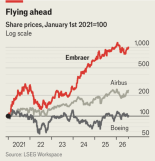
The Brazilian company is a fraction of the size of Airbus and Boeing. But it has had a remarkable few years. Demand is soaring not only for its smaller passenger planes, but also for the private and military jets it offers. In 2021 the company delivered a total of 141 planes. This year it might reach 255. On July 24th the company reported that its order backlog had reached a record $34.5bn. Francisco Gomes Neto, Embraer’s boss, sees an opportunity for “substantial growth” ahead. Investors agree. Since the start of 2021 its share price has risen roughly ten-fold, far outpacing those of Airbus or Boeing (see chart). Some now speculate that Embraer may take a tilt at the market for larger jets, going nose-to-nose with the aerospace industry’s twin giants.

screenshot-2026-08-05-alle-08-41-21-png.26139


Embraer is benefiting from a number of tailwinds. Airlines these days must wait eight to ten years for a large narrow-body plane from Airbus or Boeing, which have a combined order backlog of 16,000 passenger jets thanks to rising demand for air travel and long-running supply-chain snags dating back to the covid-19 pandemic. That has led to a surge in demand for the smaller E2, which can be delivered in less than two years.

A growing preference for direct travel between smaller airports rather than through giant hubs will further boost demand for smaller planes to fly new routes, says Ron Baur of Azorra, a leasing firm that has over 50 E2s on order. The aircraft’s only direct competitor by size is the A220 from Airbus, in a market that Embraer forecasts at 8,500 such planes over the next two decades. As Mr Gomes Neto points out, even if it is only half that number and Embraer gets half the orders, the demand will still occupy its production capacity for 20 years. Moreover, Embraer’s even smaller E175 jet is the only aircraft in production that is available to regional feeder airlines in America, owing to collective bargaining agreements with pilots’ unions that restrict the maximum size of plane they can use.

Then there is the surge in private-jet sales that has been under way since the pandemic. Embraer is dominant in the market for small and medium-sized models. Its Phenom 300, which seats up to ten passengers, has been the best seller in its class for 14 years. Booming defence spending around the world has also lifted orders for the KC390, a military-transport plane. And a controlling stake in EVE, a flying-taxi firm, looks a better bet now that the vast number of startups in the field has been whittled down to a handful of plausible survivors.

Yet Mr Gomes Neto thinks he must “prepare the company for a new cycle of products that will support more ambitious growth”. One possibility is to make a large private jet. A bolder and riskier step would be to develop a bigger commercial jet to take on Airbus and Boeing, which are expected to roll out replacements for their core narrow-body planes towards the end of the 2030s. Neither has much incentive to make big investments while the current ones are selling well, which could create an opening for Embraer.

Breaking the duopoly’s grip would be a huge undertaking. Bombardier’s attempt nearly bankrupted it and ended in a forced sale of the programme for a nominal sum to Airbus in 2018 (where it became the A220). Guillaume Faury, Airbus’s boss, has warned Embraer to “think twice”. Yet the rewards of taking even a small share of a market that Boeing puts at 36,000 jets over the next two decades would also be far greater than for a new private jet. Ron Epstein of Bank of America says it would take Embraer to the “next level”.

Embraer may never again have such an opportunity to put its experience in manufacturing and marketing commercial jets to work. Mr Gomes Neto points out that over 20 years or so it has certified almost 20 new aircraft—an impressive performance. The firm’s reputation means that prospective customers would take it seriously. But it would need to find partners to stump up some of the $10bn or so that the new plane would cost to develop, says Alberto Valerio of ubs, a bank, including perhaps an engine-maker and other suppliers, as well as customers and outside investors.

The question of whether to go after the duopoly is rumoured to divide opinion at Embraer. Luckily it has plenty of time to make a decision. As Mr Gomes Neto insists: “We are very comfortable with the situation we have”.

 

Allegati

  • Screenshot 2026-08-05 alle 08.41.21.png
    Screenshot 2026-08-05 alle 08.41.21.png
    261.8 KB · Visualizzazioni: 93
Dal lato militare, Embraer ha quel KC390 Millennium che sta iniziando a ottenere una buona quantita' di ordini, e sembra ben piazzato per sostituire il C-130, almeno per quel che ne capisco io.

Lato civile, l'E190 E2 sta vendendo abbastanza, ma ne' lui ne' il 175 possono prendersi i millemila ordini delle americane se la "scope clause" non cambia.
 
Lato civile, l'E190 E2 sta vendendo abbastanza, ma ne' lui ne' il 175 possono prendersi i millemila ordini delle americane se la "scope clause" non cambia.
D'altra parte però qual è un'alternativa al 175 per le regional americane al momento? L'ATR non riuscirebbe a coprire in modo efficiente i voli ben più lunghi che fa il 175 e il CRJ non viene prodotto. Di fatto il problema più che di Embraer (che tiene in produzione un aereo più obsoleto di quel che potrebbe produrre e ha comunque la fila di ordini) è dell'aviazione regionale americana che dipende praticamente da un solo costruttore. E come dici tu, la produzione non starà mai al passo con la richiesta di aeromobili, anche ipotizzando il semplice ricambio della flotta di ogni compagnia.
 
  • Like
Reactions: Scarab
al lato militare, Embraer ha quel KC390 Millennium che sta iniziando a ottenere una buona quantita' di ordini, e sembra ben piazzato per sostituire il C-130, almeno per quel che ne capisco io.

Con l'aria che tira adesso in Europa, se in Embraer se la giocano bene, il KC390 diventa un best seller, a partire dalla 46^ Aerobrigata di Pisa.
In ambito NATO, il KC390 è già in uso da parte di Portogallo e Ungheria.

In più è stato ordinato da:
- Repubblica Ceca
- Austria, Svezia e Olanda (tramite accordo trilaterale)
- Slovacchia
- Lituania

L'epoca del C-130 si sta avviando al tramonto, anche perché LM non ha tirato fuori alcun successore finora.
Certo, c'è sempre il più grande A400M da battere, ma essendo entrambi prodotti non americani, credo che ci sarà spazio per tutti in Europa.
 
D'altra parte però qual è un'alternativa al 175 per le regional americane al momento? L'ATR non riuscirebbe a coprire in modo efficiente i voli ben più lunghi che fa il 175 e il CRJ non viene prodotto. Di fatto il problema più che di Embraer (che tiene in produzione un aereo più obsoleto di quel che potrebbe produrre e ha comunque la fila di ordini) è dell'aviazione regionale americana che dipende praticamente da un solo costruttore. E come dici tu, la produzione non starà mai al passo con la richiesta di aeromobili, anche ipotizzando il semplice ricambio della flotta di ogni compagnia.

Sono d'accordo, ma la logica oramai e' volata fuori dalla finestra.

Con l'aria che tira adesso in Europa, se in Embraer se la giocano bene, il KC390 diventa un best seller, a partire dalla 46^ Aerobrigata di Pisa.
In ambito NATO, il KC390 è già in uso da parte di Portogallo e Ungheria.

In più è stato ordinato da:
- Repubblica Ceca
- Austria, Svezia e Olanda (tramite accordo trilaterale)
- Slovacchia
- Lituania

L'epoca del C-130 si sta avviando al tramonto, anche perché LM non ha tirato fuori alcun successore finora.
Certo, c'è sempre il più grande A400M da battere, ma essendo entrambi prodotti non americani, credo che ci sarà spazio per tutti in Europa.

Vero. Soprattutto se quel KC390 puo' ricevere avionica europea. L'IAE v2500 e' un motore ben conosciuto, anche se a maggioranza americana.
 
  • Like
Reactions: Paolì
Con l'aria che tira adesso in Europa, se in Embraer se la giocano bene, il KC390 diventa un best seller, a partire dalla 46^ Aerobrigata di Pisa.
In ambito NATO, il KC390 è già in uso da parte di Portogallo e Ungheria.

In più è stato ordinato da:
- Repubblica Ceca
- Austria, Svezia e Olanda (tramite accordo trilaterale)
- Slovacchia
- Lituania

L'epoca del C-130 si sta avviando al tramonto, anche perché LM non ha tirato fuori alcun successore finora.
Certo, c'è sempre il più grande A400M da battere, ma essendo entrambi prodotti non americani, credo che ci sarà spazio per tutti in Europa.

Ci sarebbe anche il Kawasaki C-2, che è uno dei pochi prodotti militari che i giapponesi abbiano mai cercato di vendere all'estero (con nessun successo, finora), però è decisamente più grosso del KC390.

DaV
 
Ci sarebbe anche il Kawasaki C-2, che è uno dei pochi prodotti militari che i giapponesi abbiano mai cercato di vendere all'estero (con nessun successo, finora), però è decisamente più grosso del KC390.

DaV
Ci stanno provando anche con il pattugliatore marittimo P-1, con interesse anche da parte dell’Italia ma, immagino, con grosse incognite riguardo avionica ed interoperabilità con i partner NATO.