EasyJet : risultati al 30.09.2014


kenyaprince

Amministratore AC
Staff Forum
20 Giugno 2008
29,947
547
VCE-TSF
[TABLE="width: 430"]
[TR]
[TD]Results for the year ended 30 September 2014
[/TD]
[/TR]
[TR]
[TD]

[TABLE="width: 428"]
[TR]
[TD][/TD]
[TD]2014
[/TD]
[TD]2013[/TD]
[TD]Change[/TD]
[/TR]
[TR]
[TD]Total Revenue (£ million)[/TD]
[TD]4,527
[/TD]
[TD]4,258[/TD]
[TD]+6.3%[/TD]
[/TR]
[TR]
[TD]Profit before tax (£ million)[/TD]
[TD]581
[/TD]
[TD]478[/TD]
[TD]+21.5%[/TD]
[/TR]
[TR]
[TD]Pre-tax margin (%)[/TD]
[TD]12.8%
[/TD]
[TD]11.2%[/TD]
[TD]+1.6ppt[/TD]
[/TR]
[TR]
[TD]Basic earning per share (pence)[/TD]
[TD]114.5
[/TD]
[TD]101.3[/TD]
[TD]+13.0%[/TD]
[/TR]
[TR]
[TD]Proposed ordinary dividend per share (pence)[/TD]
[TD]45.4
[/TD]
[TD]33.5[/TD]
[TD]+35.5%[/TD]
[/TR]
[TR]
[TD]Return on capital employed (%)[/TD]
[TD]20.5%
[/TD]
[TD]17.4%[/TD]
[TD]+3.1ppt[/TD]
[/TR]
[/TABLE]

Drive demand, conversion and yields across Europe
• Total revenue per seat increased by 1.2% on a reported basis, and by 1.9% on a constant currency basis to £63.31 in a higher capacity environment. The growth in revenue per seat was driven in part by a number of digital and revenue management initiatives and a continued focus on capital allocation. Second half revenue per seat on a constant currency basis grew by 1.9%.
• Seats flown grew by 5.1% to 71.5 million.
• Load factors increased by 1.3 percentage points to 90.6% and passenger numbers rose by 6.6% to 64.8 million.

Maintain cost advantage
• Cost per seat excluding fuel decreased by 1.2% on a reported basis but increased by 0.6% on a constant currency basis to £37.70 driven by increases in charges at regulated airports offset by the continued delivery of easyJet lean initiatives. Second half cost per seat on a constant currency basis increased by 0.7%.
• easyJet lean delivered sustainable savings of £32 million in the year of which £18 million were delivered in the second half.
• CFM selected to supply engines for future deliveries of current and new generation aircraft delivering one-off cost savings.

Build strong number one and two network positions
• New bases opened at Hamburg and Naples during the year and new bases announced for Amsterdam and Porto.
• easyJet started flying the former Flybe slots at London Gatwick on 30 March 2014.
• Options and purchase rights exercised over 35 A320 aircraft to take advantage of profitable growth opportunities.

Disciplined use of capital
• Return on capital employed grew by 3.1 percentage points to 20.5%.
• easyJet ended the financial year with £985 million of cash and money market deposits, a decrease of £252 million against the position at 30 September 2013 which reflects the continued cash generation of the business offset by the payment of a £133 million ordinary dividend and a special dividend of £175 million to shareholders in the year, pre-delivery payments for new aircraft and repayment of borrowings.
• The Board is recommending an increased ordinary dividend to shareholders of £180 million or 45.4 pence a share based on its enhanced ordinary dividend policy of paying out 40% of annual profit after tax.

Commenting on the results, Carolyn McCall easyJet Chief Executive said:
“easyJet has continued to execute its strategy, delivering another strong performance and enabling easyJet to deliver record profits for the fourth year in a row. We are also proposing to increase the proportion of our profits after tax paid in dividends from one third to 40%, reflecting our confidence in the future of easyJet.

“Our performance demonstrates our continued focus on cost and progress against every strategic revenue priority. Our people are fully aligned behind our strategy and this gives us strong momentum to continue delivering.

“easyJet has opened up clear blue sky between us and our competitors – both legacy and low cost - with our unique and winning combination of the best route network connecting Europe’s primary airports, with great value fares and friendly service.

“I would like to thank all of our people who have worked so hard to deliver sustainable growth and returns for our shareholders."[/TD]
[/TR]
[/TABLE]


fonte : Easyjet
 
[TABLE="width: 430"]
[TR]
[TD][h=1]easyJet customer retention and loyalty reach record levels[/h][/TD]
[/TR]
[TR]
[TD]easyJet, the UK’s largest airline, has today reported that it has increased the proportion of bookings made by existing customers to 57%, up from 50% in 2010. This means that over 37m passengers are rebooking each year compared to 25m four years ago - a 50% increase. The figure for returning business customers is even higher at 62%.

Loyalty supports both revenue growth and cost control because it is much more cost effective to retain existing customers than to find new customers.

To drive this trend still further the airline has launched a trial of a frequent flyer loyalty scheme to reward most regular passengers. The trial, which has been running for the past three months and involves more than 15,000 passengers in the UK, France and Switzerland, has been well received by the trial group with 91% telling us it is appealing to them.

Benefits to participants of the trial scheme include increased flexibility on bookings, a price guarantee and a dedicated phone number.

Carolyn McCall, Chief Executive Officer of easyJet, commented:

“More customers are trying us, liking us and coming back to us.

“This is testament to our winning formula of low prices and warm, friendly service, as well as our unrivalled network. Popular new initiatives like allocated seating meant many people tried us for the first time and we are absolutely focused on driving loyalty so they choose us flight after flight.

“In setting up our trial we listened to our passengers to understand what they most value and tailored the scheme to reflect this. Unlike traditional airlines difficult to use mileage schemes our loyalty scheme gives passengers benefits they really value and is simpler to run.”

The increase in loyalty over the last few years has been driven by a number of initiatives.

easyJet has the popular easyJet Plus scheme which offers customers unlimited allocated seat choice, dedicated Bag Drop and Speedy Boarding, as well as upcoming enhancements like the addition of Fast Track security at major airports in early 2015. All of this enables our customers to travel stress-free through the airport and on-board.

Across Europe, easyJet Plus membership has risen by 14% in the last 12 months to an all-time high, with retention rates having increased by over 30% in the same period, as customer recognition of the value of membership has grown strongly, particularly in Spain and Portugal.

easyJet also participates in three leading loyalty schemes - Nectar, RBS Your Points and Emirates Skywards – which enables members of these schemes to acquire easyJet flights when they redeem points.

easyJet flies more than 65 million passengers annually on more than 700 routes in 32 countries.

[/TD]
[/TR]
[/TABLE]


fonte : EasyJet
 
Loyalty supports both revenue growth and cost control because it is much more cost effective to retain existing customers than to find new customers.

To drive this trend still further the airline has launched a trial of a frequent flyer loyalty scheme to reward most regular passengers. The trial, which has been running for the past three months and involves more than 15,000 passengers in the UK, France and Switzerland, has been well received by the trial group with 91% telling us it is appealing to them.

Benefits to participants of the trial scheme include increased flexibility on bookings, a price guarantee and a dedicated phone number.

Molto interessante il fatto che stiano testando per il lancio un programma FF, anche se pare sia qualcosa di diverso e innovativo rispetto alle normali raccolte miglia. Vedremo.
 
Ultima modifica:
[TABLE="width: 430"]
[TR]
[TD]Results for the year ended 30 September 2014[/TD]
[/TR]
[TR]
[TD]

[TABLE="width: 428"]
[TR]
[TD][/TD]
[TD]2014
[/TD]
[TD]2013[/TD]
[TD]Change[/TD]
[/TR]
[TR]
[TD]Total Revenue (£ million)[/TD]
[TD]4,527
[/TD]
[TD]4,258[/TD]
[TD]+6.3%[/TD]
[/TR]
[TR]
[TD]Profit before tax (£ million)[/TD]
[TD]581
[/TD]
[TD]478[/TD]
[TD]+21.5%[/TD]
[/TR]
[TR]
[TD]Pre-tax margin (%)[/TD]
[TD]12.8%
[/TD]
[TD]11.2%[/TD]
[TD]+1.6ppt[/TD]
[/TR]
[TR]
[TD]Basic earning per share (pence)[/TD]
[TD]114.5
[/TD]
[TD]101.3[/TD]
[TD]+13.0%[/TD]
[/TR]
[TR]
[TD]Proposed ordinary dividend per share (pence)[/TD]
[TD]45.4
[/TD]
[TD]33.5[/TD]
[TD]+35.5%[/TD]
[/TR]
[TR]
[TD]Return on capital employed (%)[/TD]
[TD]20.5%
[/TD]
[TD]17.4%[/TD]
[TD]+3.1ppt[/TD]
[/TR]
[/TABLE]
[/TD]
[/TR]
[/TABLE]

Aggiungo il risultato netto, pari a 450 M£ (398 nel 2013), pari a 562 M€.
Complimenti.

http://corporate.easyjet.com/~/medi...centre/2014/2014-full-year-results-18-nov.pdf
 
Segnalo una interessante intervista al CEO di Easyjet sul 24 ore di oggi se qualcuno riesce a riportarla.

Tra le cose interessanti dicono che l'Italia si conferma un mercato strategico e fondamentale per Easyjet e che performa meglio della media. A fronte di un impressionante dato del 90% di load factor medio annuale sull' intero network, l'Italia è al 92%. Contestano le dichiarazioni di Vueling di essere diventata la seconda compagnia di FCO, secondo i loro dati è Easyjet.

Ma soprattutto la notizia piu' rilevante: è stato istituito un tavolo col ministro Lupi per monitorare la riassegnazione degli slot Alitalia inutilizzati a Linate.
 
Segnalo una interessante intervista al CEO di Easyjet sul 24 ore di oggi se qualcuno riesce a riportarla.

Tra le cose interessanti dicono che l'Italia si conferma un mercato strategico e fondamentale per Easyjet e che performa meglio della media. A fronte di un impressionante dato del 90% di load factor medio annuale sull' intero network, l'Italia è al 92%. Contestano le dichiarazioni di Vueling di essere diventata la seconda compagnia di FCO, secondo i loro dati è Easyjet.

Ma soprattutto la notizia piu' rilevante: è stato istituito un tavolo col ministro Lupi per monitorare la riassegnazione degli slot Alitalia inutilizzati a Linate.

Qualcuno di buona volontà la può pubblicare ?
 
ECONOMIA


easyJet: ceo, Italia per noi resta strategica (Sole)


08:52 ROMA (MF-DJ)--"L'Italia e' piazza assolutamente strategica per EasyJet con performance anche superiori alla media". Lo ha detto a Il Sole 24 ore il ceo di easyJet, Carolyn Mc Call, aggiungendo che "ci piacerebbe un po' piu' di concorrenza e di liberalizzazione del mercato. Andrebbero inseriti obiettivi di maggiore efficienza negli investimenti aeroportuali e magari avviato un ripensamento sul numero degli scali. Forse sono troppi". Mc Call ha poi spiegato di guardare con fiducia al tavolo che il ministro dei Trasporti, Maurizio Lupi, ha promesso per monitorare l'assegnazione degli slot Alitalia a Linate, mentre guarda con cautela alla dichiarazione di Vueling che su Roma ha detto di essere la seconda compagnia: "nell'anno chiuso a fine settembre -ha precisato Mc Call- eravamo noi. Ora hanno dichiarato nuovi volumi, vedremo". Il ceo di easyJet si e' poi detta curiosa di conoscere i destini di Alitalia: "vuole sapere che cosa penso dell'operazione con Etihad? Un buon affare per Alitalia, soprattutto per il lavoratori del gruppo. Ma credo che sia necessario un ripensamento globale sulla natura stessa di Alitalia", ha concluso. red/vs (fine) MF-DJ NEWS 1908:51 nov 2014
 

Molto interessante, sembrerebbe un programma FF dove non è il pax a doversi iscrivere ma è la compagnia che se rientri nei loro parametri di viaggiatore frequente sarebbe interessante conoscere quanti voli bisogna fare, ti invita a questo programma che ha dei benefici diversi dai soliti voli omaggio che non sono previsti. Altre compagnie propongono qualcosa di simile?
 
EasyJet, su gli utili nell'esrcizio 2013/2014


I profitti salgono del 13%, frutto dell'aumento dei ricavi per posto offerto e del contenimento dei costi. Nel Belpaese dati superiori alle media. Il direttore per l'Italia, Ouseley: "Un investitore straniero che crea posti di lavoro in Italia andrebbe trattato meglio"

MILANO - Easyjet, la compagnia aerea britannica, presenta numeri in crescita alla chiusura dell'esercizio fiscale allo scorso settembre. Il vettore Uk ha segnato profitti in progresso del 13% nel bilancio 2013/2014, a 450 milioni di sterline (circa 564 milioni di euro al cambio attuale), dai 398 milioni conseguiti nell'esercizio precedente. Si tratta di risultati superiori alle aspettative del mercato, accolti con soddisfazione dal direttore per l'Italia, Frances Ouseley. La manager sottolinea come easyJet si confermi una compagnia "estremamente profittevole, con un ritorno sul capitale impiegato al 20,5%", in crescita di oltre 3 punti percentuali sull'esercizio precedente.

Alla luce di questi numeri, frutto della crescita dei ricavi per posto offerto e della diminuzione dei costi relativi, il management ha deciso di estendere il dividendo in linea con la politica di distribuzione del 40% degli utili: la cedola sarà di 180 milioni o 45,4 pence per azione. Nessuna indicazione, al momento, per nuove distribuzioni straordinarie di liquidità, che in parte il mercato aspettava. I ricavi si sono attestati a 4,53 miliardi di sterline, il 6,3% in più del settembre 2013.

Per Ouseley, l'anno concluso dimostra "la capacità di contenere i costi, ma senza impattare sulla qualità dell'offerta al cliente". Già da tempo, infatti, easyJet si è smarcata dal segmento puramente low-cost inserendo nell'offerta commerciale caratteristiche proprie dei voli tradizionali, sfruttando il web in maniera innovativa, con una particolare attenzione alla clientela business.

L'offerta complessiva di posti ha raggiunto la quota di 71,5 milioni, il 5,1% in più in dodici mesi. "I ricavi per posto offerto sono aumentati dell'1,2% a valuta corrente, e dell'1,9% a valuta costante raggiungendo 63,31 sterline", ha sottolineato la compagnia in una nota. "La crescita dei ricavi per posto deriva dall'efficacia delle iniziative in ambito 'digital' e da una continua attenzione all'allocazione del capitale". Di contro, i costi sono diminuiti dell'1,2% a valuta corrente, ma saliti dello 0,6% a moneta costante.

Anche l'Italia ha registrato ottime performance. Spiega Ouseley: "Abbiamo visto una crescita a tassi del 6%, al di sopra della media europea. Il load factor è al 92% (sopra il 90,6% di gruppo, ndr), i passeggeri ormai sono 14,4 milioni (+7%) su 15,6 milioni di posti offerti". I passeggeri italiani rispondono bene: "In questi anni abbiamo investito molto per raggiungere la nostra posizione, fortemente differenziata rispetto ai concorrenti. Stiamo raccogliendo il frutto, visto che i nostri dati ci dicono che l'Italia è il Paese nel quale i clienti mostrano la maggiore 'affinità' al brand easyJet". Roma e Milano sono le punte di diamante del network del vettore Uk, ma il recente investimento di Napoli, come base, paga: "Siamo soddisfatti di questo primo scorcio di operatività, siamo a 2 milioni di posti nel nostro anno fiscale e riceviamo apprezzamento dai passeggeri".

Nel risiko continentale delle compagnie, che vede molte grandi quali Air France e Lufthansa faticare (con tanto di tensioni interne e scioperi) per cercare di aggredire il segmento low-cost e Alitalia-Etihad in ristrutturazione, Ouseley crede che per easyJet le prospettive di crescita restino ancorate all'offerta di "un modo di viaggiare fortemente innovativo, che ha avvicinato sempre più persone al volo". Non preoccupa la scelta di Ryanair, la compagnia low-cost per eccellenza, di seguire la via di un'offerta più orientata al business: "Vista la scarsità di slot a disposizione in questo momento negli aeroporti principali, abbiamo un significativo vantaggio competitivo sul breve e medio termine", dice Ouseley. Che chiosa con un invito alla politica: "Credo che un investitore straniero come noi, che crea posti di lavoro, debba essere trattato meglio in Italia. Invece troppo spesso si vedono privilegiare le iniziative a favore delle compagnie 'tradizionali', che certo non vanno verso un mercato equo".


fonte: Repubblica/Economia&Finanza
 
profiles-96x30.png

[h=1]EasyJet SWOT: you must be getting things right if Stelios has gone quiet[/h]

easyjet_logo-200x.png

easyJet's most recent annual results, for the financial year ended Sep-2014, confirmed its position as one ofEurope's most profitable airlines. Its pre-tax profit of GBP581 million was 22% higher than last year and its operating margin of 12.8% was up 1.1 ppts from last year. Among European airlines, easyJet ranks second only to Ryanair's 16.5% margin for the same 12 month period. According to its own measure of return on capital employed, it ranks first among leading European airlines and in the first quartile of companies from all sector's in the UK's benchmark FTSE 100 stock market index.
Significantly, these results seem to have silenced easyJet's founder and largest shareholder Sir Stelios Haji-Ioannou, who has also been its greatest critic in recent years since resigning from the Board in 2010. The proposed annual dividend will be 36% higher than last year and Sir Stelios' family stands to receive GBP63 million. One of the rare successes in the airline sector, CAPA analyses easyJet's strengths, weaknesses, opportunities and threats in this report.


[TD="bgcolor: #0054A4"] CAPA's first Americas Aviation Summit will he held at the Hilton Lake Las Vegas Resort & Spa on 27/28 April 2015. To experience CAPA’s unique aviation conference format and to meet the movers and shakers in the Americas and worldwide with 20+ airline CEOs, click here: CAPA Americas Aviation Summit
[/TD]

[h=2]EASYJET STRENGTHS[/h][h=3]1. easyJet has a strong pan-European airport network[/h]easyJet's network consists of 134 airports across Europe, North Africa and the Middle East, with 704 routes. Among the top 100 airport pairs in Europe, easyJet is present on 49, more than any other airline. All but one of these routes have a primary airport at both ends. easyJet's pan-European presence gives it the number two ranking by passenger numbers within the continent. According to OAG data for the week of 24-Nov-2014, it has a winter seat capacity a share of 6.5%, behind Ryanair on 9.8% and Lufthansa on 7.6%. However, its summer seat share of 8.1% ranks it second only to Ryanair's 11.7%, according to OAG data filed for the week of 4-May-2015. easyJet's superior load factor versus Lufthansaput its passenger numbers in second place on a year round basis.
[h=3]2. easyJet's Pricing is low versus main competitors[/h]Although easyJet's average fares are not the lowest in the European short/medium haul market (that distinction belongs to Ryanair), it typically charges significantly less than full service airlines that are its main direct competition.
In the financial year to Sep-2014, easyJet's total revenue per passenger (ie including all ancillary revenues) was GBP70.4, or EUR85.9. This compares with EUR121 for the Lufthansa Group in Europe and EUR151 for Air France-KLM in Europe, Africa and Middle East in calendar 2013.
[h=3]3. Relative cost position is powerful[/h]Offering low fares is relatively simple, but ensuring that they are also profitable to the airline is more demanding. This requires low costs. easyJet's operating cost per available seat kilometre (CASK) is around 20% to 45% below FSCs with a similar average sector length.
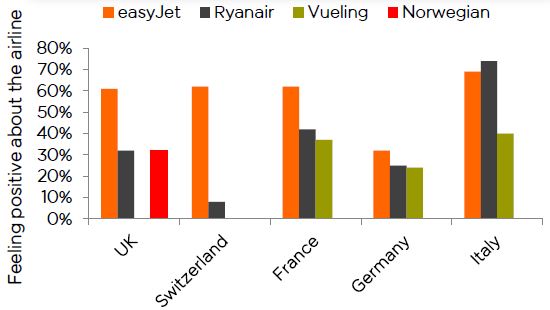
[h=3]4. easyJet's brand is strengthening[/h]easyJet has successfully raised its brand awareness in recent years. Although, to some extent, all low cost carriers have struggled with brand image, a series of features and initiatives have contributed to easyJet's gradual separation of its brand from the rest of the LCC pack.
These include improvements in on time performance, a more customer friendly website and front line service and its network of primary airports. This brand strengthening is also reflected in the upward trajectory of revenue per seat in recent years.
Brand rating of leading European LCCs in selected countries
EZ1.JPG

Source: easyJet full year results presentation 18-Nov-2014, quoting Millward Brown Brand Tracker. Data not available for Norwegian in Switzerland,France, Germany and Italy and Vueling in the UK and Switzerland
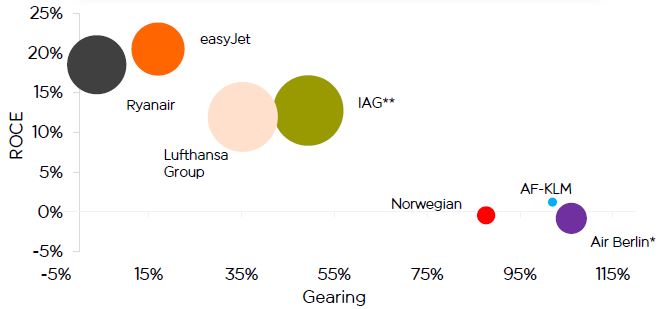
[h=3]5. easyJet's financial performance ranks among the best in Europe[/h]easyJet has become one of Europe's leading airlines by financial performance over the past few years. Its FY2014 pre-tax profit of GBP581 million, at a pre-tax margin of 12.8%, compares with a result of GBP248 million in FY2011 (7.2% margin).
Over the same period, FY2011 to FY2014, its pre-tax profit per seat has more than doubled from GBP3.97 to GBP8.12 and its return on capital employed (ROCE) has grown from 9.8% to 20.5%. This makes it one of the few airlines that is consistently earning returns above its cost of capital.
Return on capital employed for leading European airline companies year to Sep-2014
EZ2.JPG

*Air Berlin as at 30 June 2014
**IAG Balance Sheet at Sep not available, therefore average capital employed at June used in ROCE calculation & Gearing position is at 30 June 2014
Source: easyJet full year results presentation 18-Nov-2014

[h=2]EASYJET WEAKNESSES[/h][h=3]1. Cost base is not as low as that of Europe's ultra-LCCs[/h]As noted above, easyJet has a unit cost advantage against most competitors, but not against Europe's three ultra-LCCs Ryanair, Wizz Air andPegasus. Its CASK is around 70% higher than Ryanair’s, so it is vulnerable to direct competition on airport to airport pairs or even city to city pairs from its Irish rival.
Although the two only compete head to head rarely, this competition is likely to increase as Ryanair grows its presence in primary airports and attacks the business traveller segment where easyJet has had a head start.
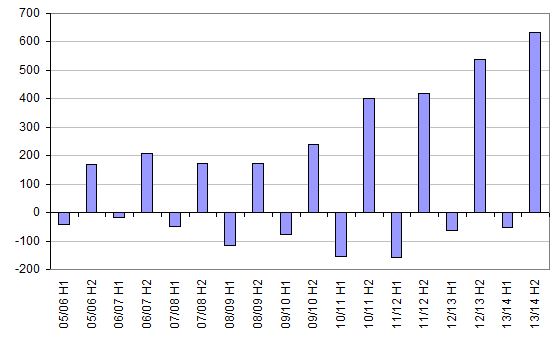
[h=3]2. Seasonal earnings pattern persists[/h]Like most European airlines, easyJet's annual profits rely heavily on a strong summer half year (April to September) to offset a loss-making winter (October to March). This reflects the seasonality of demand, with leisure traffic in particular being much higher in the summer than in the winter. Nevertheless, over the past two years, easyJet has reduced its 1H loss by two thirds and increased its 2H profit by a half.
Although 2H still accounts for more than 100% of its annual profit, its dependency on the summer months has reduced slightly.
easyJet’s half yearly profit before tax (GBP million) FY2006 to FY2014*
EZ3.JPG

*Note: Sep year end
Source: CAPA - Centre for Aviation, easyJet

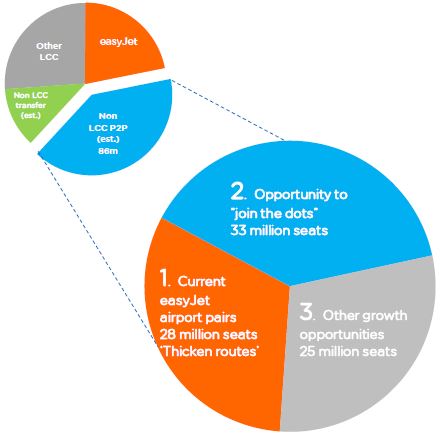
[h=2]EASYJET OPPORTUNITIES[/h][h=3]1. Further profitable growth opportunities exist[/h]Focusing on its top 20 airports in the year to Sep-2014, easyJet has a total market share of around 20% by number of seats. Excluding the market already taken by other LCCs and by non-LCC transfer traffic, easyJet estimates that there are 86 million seats operated by non-LCCs on point to point routes at its top 20 airports, giving it a relatively low risk opportunity for growth within its current network through taking market share from higher cost competition.
easyJet's opportunity at its top 20 airports
EZ4.JPG

Source: easyJet, quoting OAG scheduled data for the 12 months to 30 September 2014
[h=3]2. Further growth potential in business travellers[/h]The number passengers travelling for business purposes with easyJet has increased from less than 10 million in FY2011 to 12 million in FY2014, around 20% of the total. Business travellers are attracted by its primary airports, high frequencies on key business routes and the offer of a bundled product with features aimed at business travellers, such as bag check-in, fast track security and flexibility included for a single price.
In addition, easyJet's distribution strategy allows it to reach this market through more appropriate channels than merely relying on its own website. It was one of the first major European LCCs to implement agreements with the GDS companies, online travel agents and corporate accounts, an approach now mimicked by Ryanair. With lower fares than the principal direct competitors in its markets, easyJet is well positioned to increase its penetration of the short haul market for business travellers by taking market share from full service carriers.
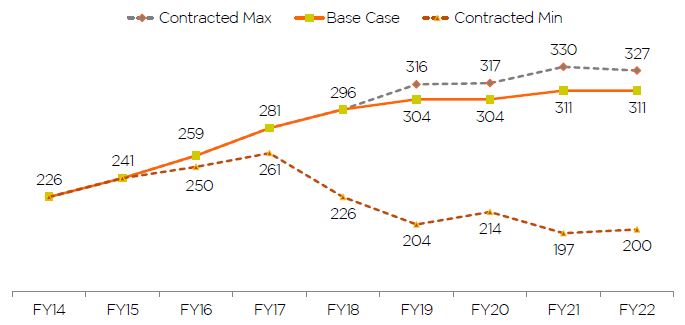
[h=3]3. Aircraft orders have a flexible delivery schedule[/h]Starting with its estimate of the opportunities presented at its top 20 airports, easyJet sees the need for an additional 20 to 30 aircraft to accommodate natural market growth of 2.2% pa; 40 to 65 to capture growth in its existing network (thickening existing routes and joining the dots); and 30 to 45 from new network points and routes. Net of route churn, this would take its current fleet of 226 aircraft to a requirement of between 296 and 356 in FY2019. easyJet has exercised its final 27 purchase rights over A320 ceo aircraft delivery between 2015 and 2017 and will then take delivery of 100 A320 neo aircraft from 2017 to 2022.
Under its base case, the fleet plan will take the FY2019 total to 304 aircraft, at the lower end of its requirement range, with flexibility to raise it to 316, or to cut quite significantly to 204, depending on market conditions. The base case total for FY2019 would represent compound average annual growth of 6% pa from FY2014. The upgauging of the fleet to include a growing proportion of A320s versus A319s and the introduction of the A320 neo will contribute to savings in cost per seat.
easyJet fleet plan to FY2022
EZ5.JPG

Source: easyJet full year results presentation 18-Nov-2014
[h=3]4. Unit cost reduction opportunities still exist[/h]As note above, easyJet's ability to undercut its main competitors on pricing depends on maintaining its cost advantage.
There is scope for cost savings, as identified under its 'easyJet lean' programme. Key sources of improved cost efficiency are engineering andmaintenance, airport deals, engine selection, the upgauging of the fleet (see above) and the introduction of the A320 neo from 2017.
[h=2]EASYJET THREATS[/h][h=3]1. Competitor response/Ryanair[/h]One of the main threats to easyJet's plans to grow its share of point to point traffic in its existing airport network is the possible competitor response. As full service carriers increasingly offer unbundled short haul fares, seat only pricing can be fairly competitive with easyJet in some cases. Nevertheless, provided that easyJet continues to maintain its cost advantage, it should be able to under-price most competitors on average by a significant percentage.
Ryanair's recent moves to improve its customer service, to increase the number of primary airports in its network and to target business passengers is perhaps a more credible threat, especially given Ryanair's unit cost advantage versus easyJet. That said, this threat is one for the longer term, given the relative lack of airport overlap between the two.
See related report: Ryanair SWOT: low costs remain the key strength, even as customer service enhancements take root
[h=3]2. External events/accident[/h]Air travel, regardless of the carrier, is vulnerable to geopolitical events and natural phenomena such as earthquakes and volcanic ash disruption. easyJet’s relatively focused geographic exposure arguably mitigates this exposure relative to airlines with a more global network. Alternatively, a Europe-wide event would hurt particularly. With a hitherto unblemished record when it comes to fatal accidents, public perception could be adversely affected if easyJet were to be involved in a major crash.
[h=3]3. The economy[/h]The airline industry is economically cyclical, although LCCs in Europe have often performed well in a downturn as FSCs have often accelerated their capacity cuts and passengers have traded down in times of austerity. Nevertheless, easyJet's relative dependence on primary airports and premium product features may leave it more exposed to the economic cycle than a pure LCC whose passengers are mainly price-motivated.
[h=3]4. Cost creep[/h]easyJet's efforts to increase its attraction to business travellers are aimed at growing its yields, but this only makes sense if this is not offset by corresponding growth in unit costs. The shift towards a more premium product positioning comes with a risk of adding cost, although easyJet's track record so far suggests that its management is capable of managing this risk.
[h=3]5. Labour unrest[/h]As with any labour-intensive service industry, airlines are vulnerable to labour unrest, not only among their own staff, but also among key airport-based suppliers such as ATC, ground-handling, security and ground transport.
While easyJet has a much better history of labour relations than most legacy carriers (and is no specific current cause for concern), its size, geographical diversity and growing unionisation increase the risk of internal labour disputes.
[h=2]Conclusion: easyJet is getting things right[/h]easyJet founder Stelios’ shareholder activism has forced management to account for every decision, to focus on return on capital and to increase its appeal to shareholders by paying regular dividends. Nevertheless, his one-time implied threat to sell his shares if management placed a new aircraft order has not been carried out. Previously, every major announcement by easyJet, whether earnings reports or aircraft orders, was quickly followed by a critical reaction from Stelios.
Strong cash generation, regular and growing dividends, value-creating return on capital and a share price that has quadrupled over four years are strong evidence that easyJet has been getting things right. Stelios' acquiescence finally seems to signal that he now recognises this too. He would seem to have little to complain about.