
M
malpensante
Guest

OCTOBER 30, 2008
Airlines Plot Latin America Course
By PAULO PRADA
As fallout from this year's economic crisis has rippled across the globe, international air travel has shrunk everywhere except in one region: Latin America.
Even as the region's stock markets and currencies tumbled into a tailspin this month and exports from Latin America began to slow, airlines have continued to perform well in the area. Growth in Latin America revenues for American Airlines and Continental AirlinesInc., two of the carriers with the greatest reach into the region, outpaced those on any other international routes in the third quarter.
AMR Corp.'s American next month will launch new flights to Brazil, the region's biggest and most promising economy, with one route serving Recife and Salvador, two coastal tourist destinations, and another serving Belo Horizonte, a regional economic capital. Delta Airlines Inc. in December plans to add routes to cities in Brazil, Argentina, Colombia, Ecuador and Honduras.
"Interaction between Latin America and other markets is still in its infancy," says Peter J. Dolara, American's senior vice president for Miami, the Caribbean and Latin America. Long the U.S. carrier with the greatest ties to the region, following its 1989 purchase of routes from a dismantled Eastern Airlines, American believes "the opportunities there are just developing. The potential for travel in these countries is huge," Mr. Dolara says.
To be sure, there's no certainty that the region will hold up. And doing business in Latin America is still often difficult for U.S. airlines. Executives at American say, for example, that it takes too long to get revenue from their ticket sales in Venezuela, where banking rules mean lots of paperwork before the airline can repatriate the money. And for all Latin America's newfound stability following a decade of overhaul, the region still relies on a strong U.S. economy to drive international trade and much-needed foreign investment.
"It still has a history of booms and busts," warns Brian Pearce, chief economist in Geneva for the International Air Transport Association, an industry group.
Some routes to the region also remain predominantly geared toward leisure and "visiting friends and relatives" traffic -- typically the first to suffer when economic conditions worsen. In Mexico, where Delta has added flights with small, regional jets, the airline recently cut service to Querétaro and León, two small destinations, because of higher fuel costs. "The regional jets are too expensive and the next plane up is too big," says Glen Hauenstein, Delta's executive vice president for network planning.
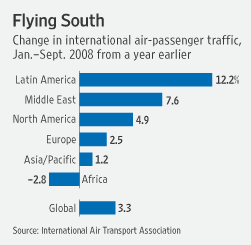
Still, the continued growth in Latin America underscores how critical international traffic remains to the recovery of U.S. airlines. Responding to an industry crisis after the terrorist attacks of Sept. 11, 2001, carriers such as American, Delta and Continental shifted service to overseas routes, where the carriers have less competition from low-cost airlines and can often charge higher fares. But the slowdown in Europe's economies now is weighing on lucrative business traffic. And Asia, another once-hot market, has cooled so quickly that many carriers have cut back on or deferred service in China.
So far, Latin America has defied the pattern. Even as international traffic shrunk in September from a year earlier in every other region of the globe -- falling almost 7% in Asia, for example -- throughout Latin America it grew by almost 2%, according to IATA. International traffic in Latin America has climbed by 12.2% so far this year from a year earlier, dwarfing a global industry average of 3.3% world-wide.
Passenger yields, or the price paid by passengers to fly one mile, on routes between the U.S. and Latin America climbed 23.2% in September from a year earlier -- far exceeding growth across the Atlantic, Pacific or within the U.S., according to the Air Transport Association, a U.S. industry group. Yields on flights to Europe, for example, climbed only 9.1%.
Third-quarter revenue per available seat mile, an industry standard, rose 19.7% from a year earlier for American on its flights to Latin America, outpacing 13.8% across the Pacific and 11.5% across the Atlantic. At Continental, the Latin America figure was 14.9%, compared with 8.6% across the Pacific and 6% for the Atlantic.
—Susan Carey contributed to this article.