
M
malpensante
Guest

THE MIDDLE SEAT
OCTOBER 28, 2008
Frequent Fliers Receive Breaks Amid Fee Craze
As airlines inaugurate a punishing flurry of fees and an aggressive round of price increases in mileage awards, there have been a couple of changes to frequent-flier programs that benefit consumers. Really.
Delta Air Lines has added a third tier to its award pricing, giving consumers more options when trying to use the miles they've earned. In the first two weeks of the new tier, Delta says customers are getting more trips at lower mileage levels than required under its old structure. Alaska Air Group Inc. will add a third tier to its Alaska Airlines awards on Nov. 19.
And a few weeks ago, AMR Corp.'s American Airlines quietly dropped its $5 booking fee to get a frequent-flier award ticket, restoring the principle that a frequent-flier award can actually be "free." (You still have to pay to get a "free" ride on US Airways Group Inc., Delta and Northwest Airlines.)
As airlines have pushed regular ticket prices much higher because of the summer run-up in oil prices, they also have increased the price of frequent-flier awards, both by increasing the number of miles you need to get a ticket and by slapping new fees on supposedly free tickets and increasing existing fees. As with baggage, food service, telephone reservations, ticketing changes and cancellations, airlines have gone fee-happy with frequent-flier tickets.
"Airlines are not using programs to generate loyalty as much as to generate fees," says Tim Winship, publisher of FrequentFlier.com. For the past five years, he says, airlines have continually eroded their loyalty programs.
But the Delta move is the first major change at a big airline that could potentially save fliers mileage and make it easier to travel using miles. Some consumers may end up paying fewer miles; others may have to pay more -- it all depends on how Delta allocates award seats.
Delta says it wants its customers to burn miles so it can sell more. Like most other carriers, Delta used to offer a basic award level with heavily restricted availability and a more-plentiful award category usually at double the price in miles. Now Delta has split the higher-priced category in two: a very pricey category with unrestricted availability, even if there is only one seat left for sale; and a lower-priced midtier that's more plentiful in terms of seats offered than the cheapest category, but not as readily available as the most expensive awards.
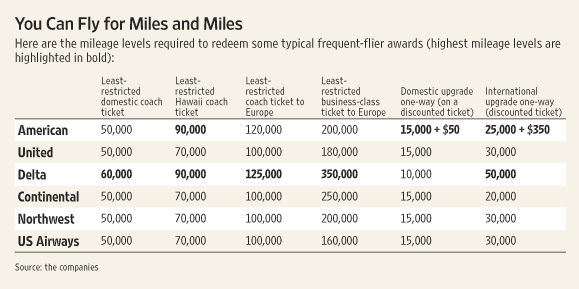
For domestic coach tickets, for example, Delta used to offer a basic limited-availability 25,000-mile award, and a 50,000-mile award with more seats available. Now at the costlier end, Delta offers a 40,000-mile award with limits on its availability and a 60,000-mile unrestricted award.
Jeff Robertson, Delta's vice president of loyalty programs, says the airline made the move in part to address customer frustration over having to pay double the price whenever the cheapest awards weren't available. "Customers unable to get access to the lower-level awards only had one other option," he says.
Delta also allows mixing and matching awards from different levels on round-trip tickets. A customer can get a seat on a departing flight at the 25,000-mile level, for example, and a return flight at the 40,000-mile level and pay a total of 32,500 miles for the ticket. Previously, customers would have been forced to bump up to the 50,000-mile level for the entire trip.
In its first two weeks, the new three-tier system saw the number of awards redeemed rise slightly, Mr. Robertson says, while the number of miles used for tickets was flat to slightly lower. Because customers usually make frequent-flier ticket-redemption decisions more on price than schedule, Delta expects more customers will trade down to the 40,000-mile level for domestic coach tickets than buy up to the 60,000-mile level.
Indeed, in an impromptu sampling on FlyerTalk.com, an online community for road warriors, nine out of 10 Delta frequent fliers couldn't get a 25,000-mile domestic coach award but ended up paying 40,000 miles, says FlyerTalk founder Randy Petersen. Previously, they would have had to pay 50,000 miles.
Any good news just about ends there for mileage junkies.
One deleterious move that could spread to other airlines is requiring cash in addition to miles for upgrades. On Oct. 1, American began charging "co-payments" to its business-class and first-class upgrades bought with mileage. A one-way coach upgrade for passengers flying on discounted coach tickets was raised to 15,000 miles plus $50 for domestic flights instead of just the 15,000 miles. International one-way upgrades on discounted tickets cost 25,000 miles plus $350 one way.
That's created a wide disparity in the cost of upgrades. Continental Airlines still offers international upgrades for 20,000 miles to travelers flying on discounted tickets. Unlike American, US Airways hasn't rolled back its "redemption fee" levied on all frequent-flier award tickets. In August, US Airways began charging $25 to claim a frequent-flier ticket for the continental U.S. and $50 for Hawaii and international destinations. Denver-based Frontier Airlines Holdings Inc. also added a $25 redemption fee last month.
You also can't currently get a "free" ticket at either Delta or Northwest, both of which add a fuel surcharge to frequent-flier tickets. Delta's fuel surcharge is $25 for domestic trips and $50 for international tickets; Northwest awards cost $25 to redeem a domestic award, $50 for trans-Atlantic tickets and $100 for trans-Pacific awards. Both say they may roll back the fuel surcharges if oil prices get less volatile and stay lower.
If you use frequent-flier miles on short notice -- often expensive but a good strategy if you have to suddenly attend a funeral or family emergency -- Delta charges a $150 fee for booking within three days of departure. Continental charges half that amount; Northwest has no last-minute booking surcharge for frequent-flier tickets.
And if you cancel a trip and want to return miles to your account, Northwest charges $50, but American, UAL Corp.'s United Airlines and Continental all charge $150. The fee to credit your miles back to your account can be as high as $250 at US Airways.
US Airways says the fee push is part of its "pay-for-what-you-use" pricing strategy, part of a plan to return to sustained profitability.
If you're frustrated by the devaluing of miles and the fees and difficulties you encounter trying to use them, there are some actions you can take:
- If you earn miles with a credit card, consider switching to a card that pays hotel points or cash back. You can often get more value redeeming points for hotels instead of airline tickets, and hotel programs generally have fewer black-out dates and availability restrictions.
- If you live in a city with adequate air service on several airlines, consider switching loyalty.
Remember, airlines will often grant elite status to top-level frequent fliers to entice switches, so you don't have to lose your status if you make a switch.
Scott McCartney